The Art of Patience: How Artisanal Jewellery Is Reclaiming Its Place in a Throwaway World
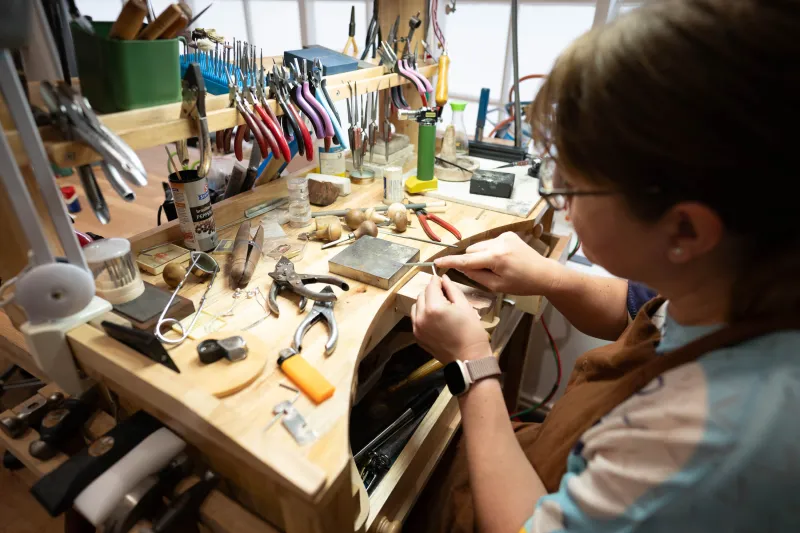
Photo: artisan goldsmith handcrafting jewellery in UK workshop studio, via www.enterprise-centre.org
There is a particular kind of satisfaction in holding something that has been made entirely by human hands. Not assembled on a production line, not extruded from a mould in a factory somewhere on the other side of the world, but shaped, refined, and finished by a craftsperson who understood precisely what they were creating. This is the quiet promise at the heart of artisanal jewellery — and it is a promise that an increasing number of British buyers are choosing to honour.
The slow fashion movement, which began as a gentle protest against the environmental devastation wrought by disposable clothing, has found an eloquent companion in the world of fine jewellery. Where fast luxury once dominated — characterised by mass-produced pieces bearing prestigious names but little genuine craftsmanship — a new sensibility is emerging. Consumers are asking harder questions. Where was this made? By whom? How long will it last? And perhaps most importantly: does it mean something?
The True Cost of Fast Luxury
The term "fast luxury" may sound contradictory, but it describes a very real phenomenon. Over the past two decades, the democratisation of aspirational goods — driven by globalised supply chains and aggressive marketing — has produced a peculiar paradox. Pieces sold at premium prices are frequently manufactured at enormous scale, with little regard for the conditions under which they are produced or the materials from which they are sourced.
The environmental toll is considerable. Mining practices associated with large-scale jewellery production have been linked to habitat destruction, water contamination, and significant carbon emissions. The human cost, too, is well-documented: exploitative labour conditions persist across parts of the global supply chain, even among brands whose marketing speaks the language of aspiration and refinement.
Contrast this with the world of the independent British jeweller. Working from a studio in Edinburgh, a workshop in Bristol, or a converted barn in the Cotswolds, these makers operate on an entirely different set of principles. Their materials are sourced with care. Their processes are transparent. And the pieces they produce are designed not for a single season, but for a lifetime — or longer.
A Conversation with the Makers
Eleanor Marsh, a goldsmith based in Derbyshire with over two decades of experience, describes the philosophy behind her practice with characteristic directness. "Every ring I make takes between twelve and twenty hours," she explains. "I know the provenance of every stone I set. I know the supplier who sourced the metal. When a customer buys from me, they're not just buying an object — they're buying a relationship with the process."
This sentiment is echoed by Marcus Trelawney, a silversmith working from a studio in Cornwall, whose pieces draw on the region's rich mining heritage. "There's an honesty to handcrafted work that you simply cannot replicate industrially," he says. "The slight variations in texture, the evidence of the maker's hand — these aren't imperfections. They're the very thing that makes a piece alive."
Both makers describe a notable shift in their clientele over recent years. Where once customers might have been drawn primarily by aesthetics, they are increasingly motivated by values. Provenance, sustainability, and the desire to support independent craft have become central to purchasing decisions in a way that would have seemed unusual even a decade ago.
Heirlooms in the Making
Perhaps the most compelling argument for handcrafted jewellery is one that transcends both ethics and aesthetics: the question of longevity. A piece made with genuine skill and quality materials does not merely endure — it accumulates meaning with the passage of time.
Sarah Whitmore, a retired teacher from Gloucestershire, purchased a hand-forged silver bracelet from an independent maker for her fortieth birthday. Twelve years later, it remains the piece she reaches for most instinctively. "It has become part of me," she reflects. "I've worn it to funerals and weddings, on ordinary Tuesdays and extraordinary occasions. I cannot imagine ever not wearing it. That's something no high-street piece has ever given me."
This capacity to become an heirloom — to carry emotional weight across generations — is something that mass production is structurally incapable of replicating. A handcrafted piece made today might be worn by a grandchild fifty years hence, carrying with it the story of its origins and the hands through which it has passed. It is, in the truest sense, an investment: not merely financial, but deeply personal.
The Environmental Case for Choosing Carefully
Beyond sentiment, the environmental argument for slow jewellery is grounded in measurable reality. Independent makers typically source from certified ethical suppliers, use recycled precious metals wherever possible, and produce in small quantities that generate minimal waste. Many operate studios powered by renewable energy and package their work in sustainable materials.
The contrast with industrial production could scarcely be more stark. A single large-scale jewellery manufacturer may produce millions of units annually, each requiring mined materials, chemical treatments, and global shipping. The aggregate impact is staggering — and it is an impact that the discerning buyer can meaningfully reduce simply by choosing differently.
Organisations such as the Responsible Jewellery Council and the Fairtrade Gold programme have made it easier for consumers to identify makers who operate to rigorous ethical standards. An increasing number of British independent jewellers hold certification from one or both bodies, providing a further layer of assurance for buyers who wish to align their purchases with their values.
Finding Your Sanctuary in the Considered Choice
The slow fashion movement asks us to resist the seductive pull of the immediate and the disposable. It asks us to consider not just what something looks like today, but what it will mean tomorrow, next year, and in the decades to come. In the context of jewellery, this is not a counsel of austerity — quite the opposite. It is an invitation to invest more deeply, to choose with greater intentionality, and to discover the profound satisfaction of owning something that has been made with genuine care.
At Sanctuary Jewellery, this philosophy is not merely an aspiration — it is the foundation upon which every piece is conceived and created. The handcrafted pieces we celebrate are not products in the conventional sense. They are expressions of a craft tradition that stretches back centuries, rendered in forms that speak to the present moment without surrendering their connection to enduring quality.
To choose artisanal jewellery is to choose a different relationship with adornment altogether — one defined not by trend cycles and marketing campaigns, but by the quiet, lasting satisfaction of the beautifully made. In a world that moves ever faster, that choice is, perhaps, its own kind of sanctuary.