Returning to the Source: Why Independent British Jewellers Are Winning Back Our Hearts and High Streets
A Quiet Revolution in Plain Sight
Walk along the cobbled lanes of York, the independent quarters of Bristol's Clifton Village, or the tucked-away arcades of Edinburgh's Old Town, and you will notice something that was, until recently, in danger of disappearing altogether. Behind modest shopfronts, often adorned with hand-lettered signage and softly lit display cases, independent jewellers are once again drawing customers in — not through footfall algorithms or loyalty card schemes, but through something far older and more compelling: genuine craft, personal attention, and a story worth telling.
This resurgence is not coincidental. It is the product of a broader cultural reckoning — one in which British consumers, weary of the hollow promise of convenience retail, are beginning to ask harder questions about where their possessions come from, who made them, and what they truly represent.
The Limits of the Shopping Mall
For much of the past three decades, the high street jewellery market was dominated by a handful of national chains. Gleaming under uniform fluorescent lighting, their displays offered accessible price points and reassuring familiarity — but precious little soul. A ring purchased in a Trafford Centre concession looks identical to one bought in Bluewater or Meadowhall. The piece carries no fingerprint, no regional identity, no maker's narrative.
It is precisely this anonymity that has begun to trouble a growing number of buyers. When jewellery is reduced to a commodity — standardised, interchangeable, produced at volume — it loses the very quality that makes it meaningful. Jewellery, at its finest, is not merely decorative. It is biographical. It marks occasions, carries sentiment, and outlasts the wearer. A piece that could have been selected by anyone, anywhere, struggles to fulfil that intimate function.
Independent jewellers understood this long before the data caught up. Their survival, during years when the chains appeared invincible, depended upon offering precisely what the chains could not: individuality, expertise, and the quiet assurance of knowing the hands that shaped your piece.
Makers Who Are Rooted in Place
Consider the growing number of British jewellers who have deliberately anchored themselves to their communities — not as a marketing strategy, but as a statement of values. In Cornwall, silversmiths draw upon the county's rich mining heritage, incorporating locally sourced materials and referencing coastal landscapes in their work. In the Scottish Borders, weavers and metalworkers share creative traditions that stretch back centuries, producing pieces that carry the character of the land itself.
In cities, the story is equally compelling. Birmingham's Jewellery Quarter — once the undisputed heart of British jewellery manufacturing — is experiencing a genuine renewal. Younger makers are taking on workshops in the same Victorian streets where their craft has been practised for generations, blending inherited techniques with contemporary sensibilities. The Quarter's famous assay office, which has hallmarked British gold and silver since 1773, remains a living institution rather than a museum piece. For those who choose to work within its shadow, that continuity carries weight.
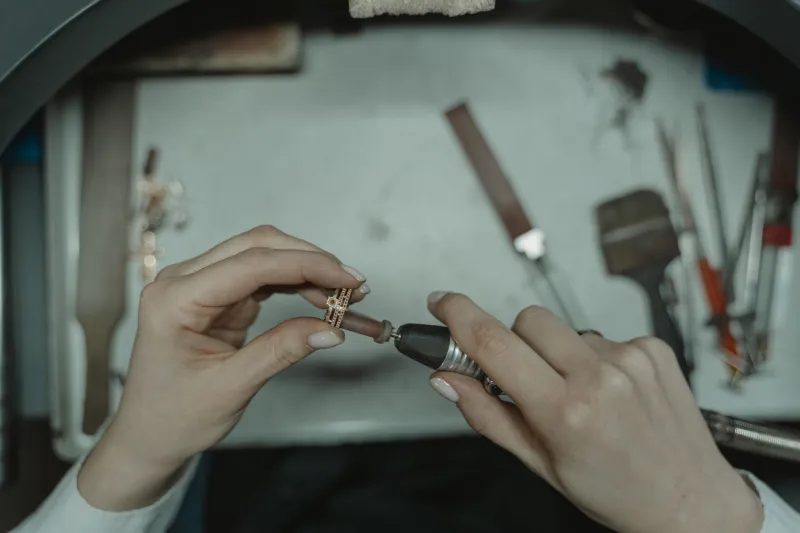
Similarly, in London's Hatton Garden, independent studios are carving out space alongside the established trade houses. These are often one or two-person operations — a trained goldsmith, perhaps a gemologist partner — who take commissions, repair heirlooms, and build relationships with clients that span years rather than transactions.
The Customer Who Returns
What draws people back to these smaller, more intimate spaces? The answers, gathered from conversations with both makers and their clients, are remarkably consistent.
First, there is the matter of knowledge. An independent jeweller who has spent fifteen years working with a particular metal or stone speaks about it with an authority that no retail script can replicate. Customers who arrive uncertain — perhaps seeking an engagement ring, or looking to reset a family stone — leave not merely with a purchase, but with an education. They understand what they have chosen and why it suits them. That understanding deepens the attachment.
Second, there is the experience of being seen. In a chain retailer, a customer is a footfall statistic. In an independent studio, they are a person with a story — a specific occasion, a particular aesthetic, a budget that deserves honest counsel. The jeweller who remembers a client's name, who recalls that their mother favoured sapphires, who sets aside a piece because it seems exactly right for someone they know — this is a relationship that the high street multiples are structurally incapable of offering.
Third, and perhaps most profoundly, there is the matter of provenance. Independent jewellers are far more likely to be able to answer the question that increasingly matters to British consumers: where did this come from? Whether that refers to the origin of a gemstone, the source of a metal, or the lineage of a technique, transparency is a currency that independent makers can offer with confidence.
Craft as Cultural Inheritance
There is something deeper still at work in this renaissance — something that connects to a particularly British sense of identity. Britain has a long and distinguished tradition of applied arts: silversmithing, enamelling, lapidary work, and the hallmarking system that remains the envy of the world's jewellery trades. These are not merely historical curiosities. They are living traditions, sustained by the makers who choose to practise them and the customers who choose to support them.
When a buyer selects a handcrafted British piece over a mass-produced import, they participate — however modestly — in the continuation of that tradition. They become, in a small but genuine sense, custodians of something worth preserving. The jewel they wear is not simply an ornament. It is an argument, made quietly and elegantly, for the enduring value of skill, patience, and care.
Finding Your Own Sanctuary
The jewellers leading this quiet renaissance are not asking for grand gestures of loyalty. They ask only that customers pause before defaulting to the familiar, and consider what a more considered choice might offer — in the quality of the piece, the richness of the story it carries, and the relationship it makes possible.
Sanctuary, as a concept, speaks to the value of spaces set apart from the noise and haste of ordinary commerce. Britain's independent jewellers offer precisely that: a place to slow down, to ask questions, to find something made with intention and worn with meaning. In returning to them, we do not merely support a small business. We reclaim a way of engaging with beauty that has always, at its best, been deeply and particularly human.