The Unhurried Hours: How Considered Jewellery Transforms the Texture of Everyday Life
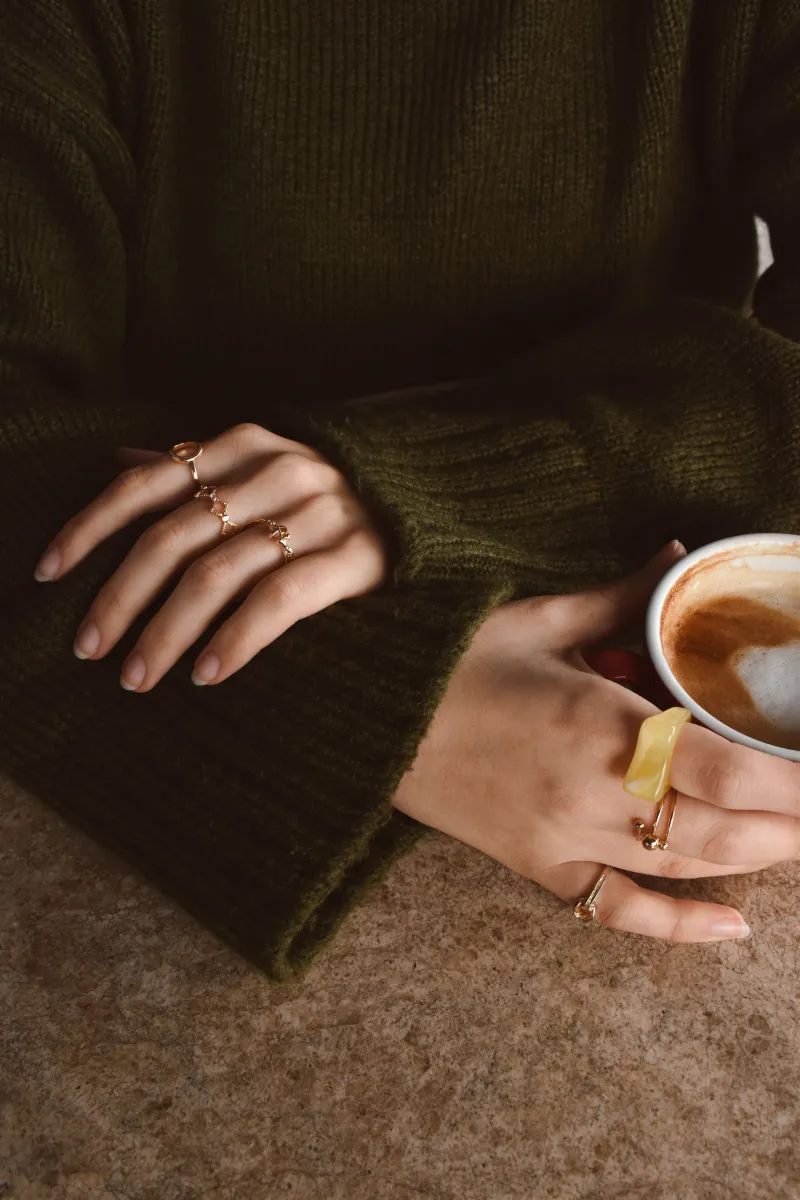
Photo: woman morning coffee ritual elegant jewellery ring necklace soft natural light lifestyle, via images.pexels.com
There is a particular quality of attention that arrives only when we slow down enough to notice. The warmth of morning light across a kitchen table. The specific weight of a favourite cup. The way a familiar scent can return you, briefly, entirely to yourself. These are the small sanctuaries of daily life — fragile, fleeting, and entirely worth protecting.
Jewellery, when chosen with intention rather than impulse, has a remarkable capacity to deepen these moments. Not through ostentation, but through presence. A well-made piece — one that has been shaped by skilled hands, in considered materials, with genuine craft behind every detail — carries a quality of attention that communicates itself to the wearer. You feel it in the weight against the skin. You notice it when light moves across a surface. You are, almost without realising, called back to the present.
What follows is not a guide to grand occasions. It is an invitation to consider the ordinary hours, and the pieces that might make them extraordinary.
One: The Morning Ritual — Fastening the Day's Intention
There is something quietly ceremonial about the act of dressing. In a culture that frequently reduces morning routines to efficiency exercises — the fastest route from bed to door — the deliberate selection and fastening of a piece of jewellery introduces a moment of pause that can reframe the entire day.
Consider a fine chain necklace, worn daily, chosen for its tactile quality as much as its appearance. The cool fall of it against the collarbone. The subtle clasp that requires a moment of focus to fasten. This small act — requiring both hands, a breath, a fraction of stillness — is, in its way, a form of intention-setting. You are not simply getting dressed. You are choosing, consciously, how you wish to meet the day.
Handcrafted pieces are particularly suited to this ritual. The slight irregularities of hand-formed metalwork, the warmth of sterling silver or 18-carat gold that has been worked rather than machine-stamped, communicate something that mass-produced pieces cannot: that care was taken in the making, and care may be taken in the wearing.
Two: The Morning Coffee — A Moment of Quiet Ownership
For many in Britain, the first cup of coffee or tea represents the one uncontested moment of the day — before obligations accumulate, before the phone demands attention, before the world reasserts its claims. It is a small act of sovereignty, and it is all the richer for being recognised as such.
A ring worn habitually becomes a companion to this moment. The eye catches it as hands wrap around a warm cup. If it is a piece with genuine character — a stone of interesting depth, a setting with considered detail — it offers a brief point of focus, a visual anchor that draws the mind away from the day's anticipated demands and back into the present.
This is not a trivial effect. The practice of noticing — attending to what is immediately before you rather than what lies ahead — is one of the most effective means of reducing the ambient anxiety that characterises modern life. A beautiful ring does not solve this problem, but it offers a gentle prompt. It says: look here. Be here.
Three: The Working Hours — Wearing What Grounds You
For those who work from home — a circumstance now familiar to a significant portion of the British workforce — the boundaries between professional and personal life have become permeable in ways both liberating and unsettling. Without the ritual of commuting or the social structure of a shared office, the day can lose its sense of shape.
Many find that wearing a specific piece during working hours — a bracelet, perhaps, or a pair of understated earrings — introduces a subtle but effective structure. It marks the working self as distinct from the domestic self. It is a small costume change that carries genuine psychological weight.
Choose a piece that is both comfortable enough for sustained wear and sufficiently considered to feel like a deliberate choice. Artisan-crafted bangles in brushed gold or oxidised silver, for instance, possess a quality of presence without demanding attention. They sit quietly at the wrist, doing their work — which is simply to remind you that you, too, are doing yours.
Four: The Evening Transition — Marking the Shift
The hour between work and evening — that liminal stretch when the day's professional obligations technically end but the mind continues to run its loops — is one of the most undervalued opportunities for intentional ritual. In many cultures, the transition from work to rest is marked by deliberate acts: changing clothes, preparing a specific drink, undertaking a brief walk. These are not luxuries. They are boundary markers, signals to the nervous system that one mode of being is ending and another beginning.
Removing a piece of jewellery worn throughout the working day can serve this function beautifully. The deliberate unfastening — setting a necklace carefully in its dish, returning a ring to its stand — mirrors the act of setting down the day's concerns. Conversely, choosing to wear something different in the evening — a pair of drop earrings, a more substantial bracelet — signals a shift in register. You are no longer in service to the day's demands. You are, for these hours, entirely your own.
This is the kind of quiet luxury that requires no audience. It is practised entirely for oneself, which is perhaps why it is so sustaining.
Five: The Night's Close — The Last Deliberate Act
The final ritual of the day — the removal and careful storage of whatever jewellery has been worn — is, in miniature, a meditation on impermanence and care. Each piece returned to its place; each clasp released with attention. It takes, perhaps, ninety seconds. In those ninety seconds, the day is gently concluded.
This is not a performance. No one is watching. But that is precisely the point. The care taken with beautiful objects when no one is present is a form of self-respect — an acknowledgement that these things matter because you have decided they matter, not because they are being observed.
A jewellery box or tray chosen with the same care as the pieces themselves completes this ritual. The act of placing a handcrafted ring in a velvet-lined space, of seeing it rest there quietly until morning, closes a small but genuine loop of intention.
The Sanctuary Within the Ordinary
None of these moments is dramatic. None requires special occasion or particular circumstance. That is, of course, the point. The sanctuary that Sanctuary Jewellery speaks to is not found only in grand gestures or milestone purchases. It is found in the accumulated texture of days lived with attention — in the small, repeated acts of choosing well, noticing fully, and caring genuinely for the things and the hours that constitute a life.
Jewellery chosen with this understanding does not merely decorate. It participates. It is present in the morning and the evening, in the working hours and the resting ones, in every quiet moment where you choose, however briefly, to be entirely where you are.