Forging Tomorrow's Heirlooms: Why the Jewellery You Choose Today May Define a Family's Legacy
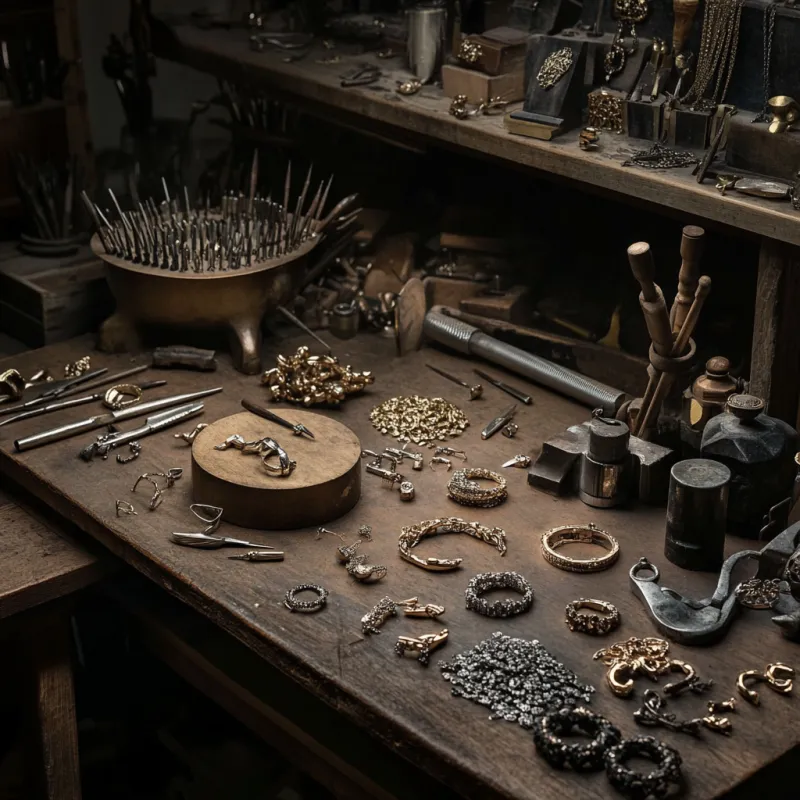
Photo: handcrafted gold jewellery artisan studio workbench UK heritage, via images.squarespace-cdn.com
There is a persistent assumption, deeply embedded in British sensibility, that an heirloom must first be old. That a piece earns its emotional weight only through the patina of decades, through the accumulation of anniversaries and absences, through having passed through hands that are no longer with us. It is a romantic notion — and not without merit. Yet it is also, on careful reflection, somewhat backwards.
An heirloom does not begin as an heirloom. It begins as a purchase, a gift, a gesture of love or self-regard. What transforms it is not time alone, but intention — and increasingly, Britain's most thoughtful artisan jewellers are building that intention into their work from the very first sketch.
The Myth of the Antique Prerequisite
When we speak of inherited jewellery, we tend to imagine it arriving already aged: a grandmother's pearl strand, a great-aunt's garnet brooch, a signet ring bearing an unfamiliar crest. These objects carry the romance of history. But consider what they once were — new acquisitions, chosen by someone with taste and means and a wish to mark a moment. The jewellery that will grace auction catalogues in 2125 is being made right now, in studios across London, Edinburgh, and the West Country.
The distinction between a piece that endures and one that does not lies in several compounding factors: the quality of materials, the integrity of construction, the timelessness of design, and — perhaps most critically — the emotional resonance it carries from the moment it is first worn. A handcrafted piece made with genuine skill and considered intention begins accumulating meaning immediately. It does not need to wait for antiquity to matter.
What British Artisans Are Building Into Their Work
Speak to any serious jeweller working by hand in the UK today, and the conversation will turn, almost inevitably, to longevity. Not merely as a commercial proposition — though durability is certainly good for reputation — but as a philosophical commitment.
Jewellers working in the traditional goldsmithing tradition speak of designing pieces that can be re-sized, re-polished, and re-set without losing their essential character. A ring that cannot accommodate the changes of an ageing hand is a ring with a limited future. A pendant whose setting is so fashionably specific to this decade that it will appear dated by the next is a piece that flatters its moment but fails its wearer's children.
The most enduring contemporary pieces tend to share certain qualities: clean lines that transcend trend cycles, settings that protect stones securely without overwhelming them, and a weight of metal that speaks of substance rather than economy. These are not accidental virtues. They are the result of deliberate choices made by craftspeople who think in generations rather than seasons.
British artisans are also increasingly attentive to the stories their pieces carry. Many now offer accompanying documentation — not merely certificates of gemstone quality, but written accounts of the materials' origins, the techniques employed, and the inspiration behind a given design. Such records transform a jewel into an artefact, giving future inheritors the context to understand what they hold.
The Psychology of Choosing With the Future in Mind
There is something quietly profound about selecting jewellery with an heir in mind. It asks us to think beyond our own lifetimes, to imagine a person not yet born holding something we have chosen, understanding something of who we were through what we valued. This is an act of both generosity and self-knowledge.
Psychologists who study material culture note that objects passed between generations carry what is sometimes described as 'biographical resonance' — a quality that makes them feel fundamentally different from items of equivalent monetary value purchased new. The brooch your mother wore to your parents' wedding does not merely have sentimental value; it has, in a measurable psychological sense, a different quality of presence than an identical brooch in a shop window.
The remarkable insight emerging from contemporary jewellery culture is that this resonance can begin accumulating from day one. A piece worn at a wedding, a birth, a milestone birthday — one chosen with care and worn with awareness — begins its biographical journey immediately. The story starts the moment it is clasped.
Practical Counsel for the Considered Buyer
For those who wish to select jewellery with genuine longevity in mind, certain principles offer reliable guidance.
Prioritise craft over novelty. A piece that relies on its trendiness for appeal will date precisely as trends do. Look instead for designs rooted in enduring aesthetic principles — symmetry, proportion, the honest display of a beautiful material. These qualities have served jewellery well for several millennia and show no signs of exhaustion.
Enquire about repairability. A well-made piece should be serviceable. Ask whether stones can be re-set if a claw wears thin, whether the shank of a ring can be built up over time, whether a clasp can be replaced without disturbing the piece's character. A jeweller who cannot answer these questions confidently is a jeweller who has not thought about your future.
Choose materials with a track record. Gold, platinum, and sterling silver have proven themselves across centuries. Fine gemstones — diamonds, sapphires, rubies, emeralds — retain both beauty and value across generations. This is not to discourage more unusual materials, but to suggest that innovation is best paired with a foundation of proven durability.
Commission rather than simply purchase. A bespoke piece, made to your specification and your story, begins its biographical life with an unusually rich inheritance. Future generations will know not merely that it was beautiful, but why it was made — which is a far more intimate form of knowledge.
Document everything. Keep receipts, certificates, and any correspondence with the maker. Write down the story of why you chose the piece, what occasion prompted it, what it meant to you. Tuck this record somewhere it will be found alongside the jewel itself. This small act of narrative generosity may prove the most meaningful thing you do.
A Living Tradition
The finest jewellery has always been a conversation between maker, wearer, and time. What distinguishes the most thoughtful contemporary work is an explicit acknowledgement of that third party — an awareness that time will have its say, and that the wisest response is to make something worthy of its attention.
At Sanctuary Jewellery, this philosophy is not an afterthought but a governing principle. Every handcrafted piece is conceived as a potential heirloom — not in the sense of imitating the past, but in the deeper sense of aspiring to the future. The question is not whether a piece is old enough to matter. The question is whether it is good enough to last, and meaningful enough to be worth keeping.
The answer to the heirloom question, it turns out, is not found in the past at all. It is made, with care and intention, in the present.