The Quiet Ritual: How a Single Piece of Jewellery Can Become an Anchor in an Uncertain World
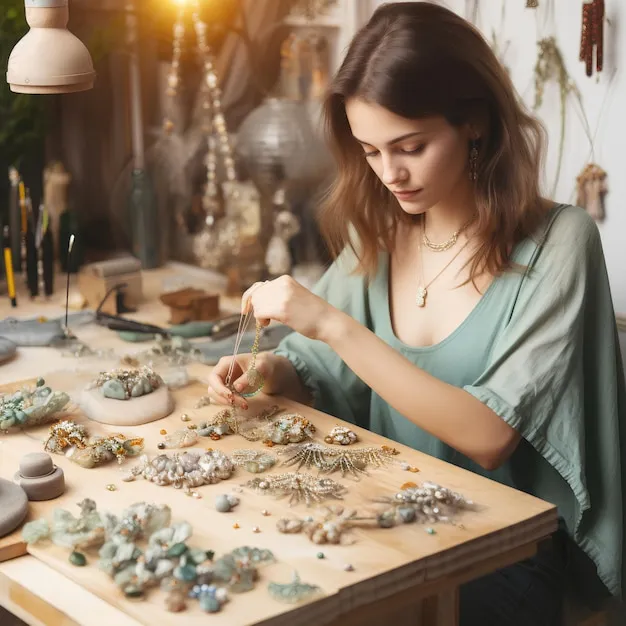
Photo: woman wearing handcrafted jewellery peaceful morning light mindfulness, via img.freepik.com
Mornings in most British households are not particularly serene. There are alarms and obligations, school runs and commutes, the low-grade anxiety of a phone already filling with demands before the kettle has boiled. And yet, for a significant number of people, there exists within this chaos a small, unhurried moment — the clasping of a necklace, the sliding on of a ring, the careful fastening of a bracelet — that functions as something close to a breath.
It is not a practice that announces itself. It carries no app, no subscription, no branded vocabulary. It is simply the act of putting on a piece of jewellery that means something, and in doing so, briefly becoming someone who is present.
The Tactile and the Mindful
Much of contemporary wellness discourse concerns itself with presence — the cultivation of attention in a world engineered to scatter it. Meditation, breathwork, journalling: these practices share a common ambition, which is to return the wandering mind to the body and the moment. What is less frequently acknowledged is that certain objects can serve a similar function, not through any mystical property, but through the simple power of the tactile.
Handcrafted jewellery, in particular, offers a quality of physical engagement that mass-produced pieces rarely match. The slight irregularity of a hand-formed band, the particular weight of a stone set by a skilled craftsperson, the warmth that metal acquires from skin — these are sensory details that register, however briefly, as real. They pull attention downward from the circling thoughts to the immediate and the physical.
Several UK-based customers who wear handcrafted pieces daily describe a pattern that will be familiar to many. Sarah, a solicitor based in Bristol, has worn the same hammered gold bangle — commissioned from a Somerset goldsmith following the birth of her daughter — every working day for six years. 'I touch it constantly without realising,' she says. 'During difficult meetings, during phone calls I'm dreading. It's become a kind of reset. I don't think about it consciously, but I notice when I've forgotten to wear it. The day feels different.'
This is not coincidence, and it is not superstition. It is the body doing what bodies do when given a consistent, pleasant tactile cue: associating it with a state, and returning to that state when the cue is present.
Objects That Carry Weight
There is a distinction worth drawing between jewellery as decoration and jewellery as object of significance. The former is chosen to complement an outfit; the latter is chosen — or received, or inherited — to mark something. It is this second category that tends to develop what might be called object-intimacy: a relationship between wearer and piece that deepens with time and accumulates meaning through association.
The handcrafted piece lends itself particularly well to this kind of significance. Because it has been made by a specific person, in a specific place, using materials with traceable origins, it arrives with more story than a factory-made equivalent. It is already, in some sense, inhabited. And as the wearer adds their own chapters — the anniversaries it witnessed, the difficult days it accompanied, the moments of unexpected joy — the piece becomes something closer to a companion than an accessory.
Martha, a teacher from Edinburgh, received a small handcrafted silver ring set with a piece of Scottish labradorite following her father's death three years ago. 'I bought it myself,' she explains, without any apology. 'I needed something to hold on to, quite literally. I found myself turning it on my finger during the funeral, during the weeks afterwards. It wasn't a replacement for grief — it didn't make anything easier. But it gave me somewhere to put my hands when I didn't know what else to do with them.'
Her account points to something important: the function of such pieces is not to resolve difficult emotions but to provide a physical locus for them. In moments of transition — bereavement, diagnosis, the end of a relationship, the beginning of one — a tangible object can offer what words and thoughts cannot: something solid to return to.
Ritual and the Ethical Dimension
There is, it should be noted, an ethical dimension to this conversation that is not merely incidental. The choice to invest in a handcrafted piece — one made with traceable materials, by a craftsperson paid fairly for their skill — is itself a form of intentionality. It is a decision that runs counter to the disposability that characterises much of contemporary consumption.
When we choose a piece made with care and conscience, we are not simply acquiring an object. We are participating in a relationship: with the maker, with the materials, and with the values that the piece embodies. This conscious participation is itself a mindful act. It asks us to slow down, to consider, to value quality over quantity and meaning over novelty.
Many people who describe a strong personal relationship with their jewellery also speak of a heightened awareness of where their pieces come from. Knowing that a stone was ethically sourced, that the goldsmith who made the setting was working in a studio rather than a factory, that the piece was designed to last rather than to be discarded — these are not abstract ethical points. They are part of the piece's meaning, woven into the satisfaction of wearing it.
The Sanctuary in Small Things
The idea of sanctuary — a protected space, a refuge from the relentless — need not be architectural. It can be as small as a ring. The jewellery we wear closest to our bodies, day after day, becomes part of the texture of our lives in a way that few other possessions manage. It travels with us, absorbs our warmth, and returns it. It is present at our best moments and our worst. It ages alongside us.
For those who have not yet found their anchor piece — the one that becomes habitual, that the hands seek out without instruction — the search itself is worth undertaking with care. Resist the impulse toward the merely beautiful or the immediately fashionable. Look instead for the piece that creates a small pause when you first hold it, that seems to ask for attention rather than simply command it.
That pause is the beginning of a ritual. And in a world that offers very few genuine moments of stillness, a ritual that fits in the palm of your hand is not a small thing at all.
Finding Your Piece
At Sanctuary Jewellery, every handcrafted piece is made with an understanding that jewellery is not merely worn — it is lived with. The weight of a well-made piece, the particular way it catches light, the story of its making: these are not peripheral details. They are the substance of the relationship that will develop between you and what you choose to wear.
If you are seeking a piece that will become more than decoration — that will, in time, become part of the quiet architecture of your daily life — we invite you to begin not with a budget or a style preference, but with a question: what do I wish to carry with me? The answer, we find, tends to lead somewhere meaningful.