Made for You Alone: The Transformative Power of Commissioning Bespoke Jewellery
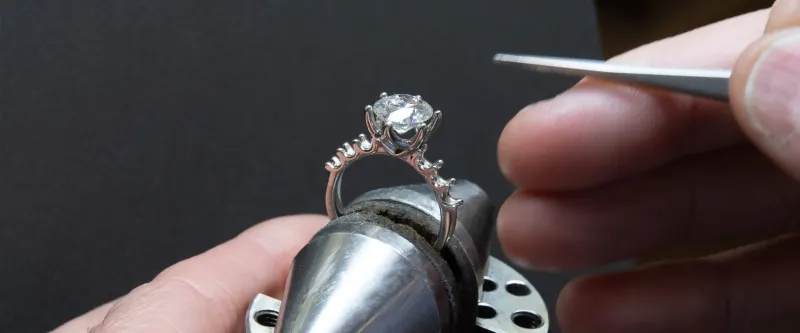
Photo: jeweller crafting bespoke ring in workshop with natural light UK, via www.laingsuk.com
There is a particular kind of stillness that settles over a person the moment they first wear a piece made entirely for them. Not chosen from a cabinet, not selected from a catalogue, but conceived, discussed, and crafted in direct response to the singular architecture of their own life. This is the quiet alchemy of the bespoke commission — and for those who have experienced it, no other form of jewellery acquisition quite compares.
At Sanctuary Jewellery, the concept of sanctuary is not merely a name. It is a philosophy. And nowhere does that philosophy find more complete expression than in the process of creating something utterly, irreducibly personal.
The Consultation: Where Stories Become Briefs
The bespoke journey begins not with metal or stone, but with conversation. For many British artisans working in this tradition, the initial consultation is the most delicate and important stage of the entire process — a careful act of listening that goes far beyond noting down preferred metals and gemstone colours.
"People rarely arrive knowing exactly what they want," explains one London-based goldsmith who has worked exclusively in bespoke commissions for over fifteen years. "They arrive knowing how they want to feel. My role in those early meetings is to understand the emotional register they're reaching for — whether that's confidence, remembrance, joy, or something they can't quite name yet."
This distinction — between aesthetic preference and emotional need — is central to what separates a truly bespoke piece from a merely personalised one. A monogram engraved on a locket is a personalisation. A ring designed to echo the particular quality of light on a Scottish loch where a couple became engaged is something else entirely. It is, in the truest sense, wearable memory.
Many artisans describe asking clients to bring objects, photographs, or even written passages to their first meeting. A pressed flower from a grandmother's garden. A fragment of vintage lace. A line of poetry that has accompanied someone through grief or transformation. These talismans become the emotional raw material from which a design gradually emerges.
Translating the Unspoken
Perhaps the most remarkable skill a bespoke jeweller possesses is the capacity to render the intangible into the tangible — to take feelings that resist language and give them form in precious metal and stone.
A silversmith based in Edinburgh describes a commission she received from a woman who had recently lost her mother. "She didn't want a memorial piece in any conventional sense," the artisan recalls. "She wanted something that captured what her mother had meant to her — this sense of being held, of safety. We spent three sessions simply talking before I drew a single line."
The resulting piece — a cuff of oxidised silver with a subtle interior engraving — became, in the client's own words, "a portable home." That phrase resonates deeply with the sanctuary ideal: the notion that a piece of jewellery, when made with sufficient care and intention, can function as a psychological refuge. Something to reach for in moments of uncertainty. Something that says, quietly and without fanfare, you are known.
This psychological dimension of bespoke jewellery is increasingly acknowledged beyond the purely anecdotal. Researchers studying material culture and emotional wellbeing have long noted the significance of objects that carry personal narrative. When an object is not merely inherited or purchased but actively co-created, its capacity to anchor identity becomes considerably more powerful.
The Making: A Collaboration Across Time
Once a design has been agreed — typically through a series of sketches, wax models, or digital renderings depending on the maker's practice — the commission enters the workshop. For the client, this period carries its own particular texture: a blend of anticipation and trust.
Many artisans keep their clients informed at key stages of the making process, sharing photographs of a setting being formed, a stone being set, or a surface being finished. This transparency is not merely practical; it deepens the client's relationship with the object before it has even been received. By the time the piece is complete, the wearer has, in a sense, already lived alongside it for weeks or months.
"I think of the making period as part of the gift," says one Derbyshire-based jeweller whose practice centres on ethically sourced materials and slow craftsmanship. "The waiting is not a delay — it is part of the experience. It asks something of the client, and that investment makes the eventual wearing more meaningful."
This philosophy of slowness runs counter to the dominant rhythms of contemporary consumer culture, where immediacy is prized above almost all else. The bespoke commission insists, gently but firmly, that some things are worth waiting for — that the interval between desire and fulfilment can itself be a space of reflection and growth.
The Unveiling: A Threshold Moment
The moment of first wearing is, for many clients, unexpectedly emotional. Jewellers speak of tears at unveilings with a frequency that suggests this is not the exception but the norm. Something about seeing one's own story rendered in precious material — held up to the light, placed against the skin — moves people in ways they did not anticipate.
"It's recognition," suggests the London goldsmith. "They look at it and think: yes, that is me. That is exactly what I meant. And that feeling of being truly understood — even by an object — is quite profound."
This is the essence of what bespoke jewellery offers that no ready-made piece, however beautiful, can fully replicate. It is not simply a superior product. It is a relationship — between maker and wearer, between intention and craft, between the life that has been lived and the life that continues to unfold.
Finding Your Artisan
For those considering a bespoke commission for the first time, the choice of maker is as personal as the piece itself. Seek out jewellers whose existing work resonates with you aesthetically, but pay equal attention to how they communicate. The best bespoke relationships are built on mutual trust and a shared willingness to explore.
Many British artisans offer initial consultations free of charge or at modest cost, and professional bodies such as the Goldsmiths' Company maintain registers of skilled makers working across the United Kingdom. Independent jewellers' quarters in cities including Birmingham, Edinburgh, London, and Bristol offer opportunities to meet makers in their own environments — spaces that often carry, in themselves, a particular quality of sanctuary.
A bespoke piece is rarely the least expensive option. But measured against what it offers — an object that is genuinely, irreversibly yours, made with care and intention by hands that have listened — it may well be the most valuable thing you ever wear.