The Weight of Gold: What Ethical Sourcing Really Means for Today's Jewellery Buyer

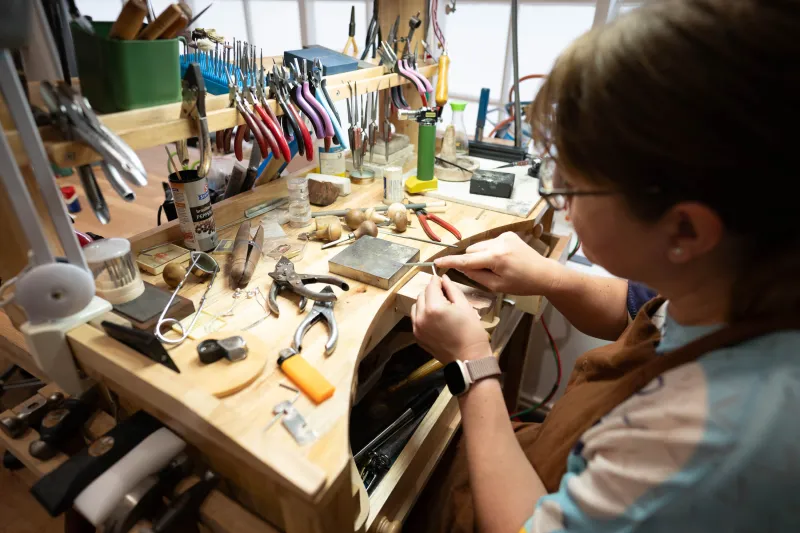
Photo: ethical gold jewellery workshop artisan responsible sourcing UK, via static.wixstatic.com
Gold has always carried symbolic weight. Across cultures and centuries, it has signified permanence, devotion, and worth. Yet behind the gleam of a newly cast band or the warmth of a pendant resting at the collarbone lies a supply chain of considerable complexity — one that, until relatively recently, most consumers had little cause or opportunity to scrutinise.
That has changed. Driven by a confluence of environmental consciousness, social awareness, and a broader cultural reckoning with the true cost of luxury, a growing number of UK jewellery buyers are now asking questions that would have seemed unusual a generation ago: Where was this gold mined? Under what conditions? Who profited, and who was harmed?
These are not comfortable questions. But they are necessary ones — and the jewellers and craftspeople who are engaging with them honestly are, in the process, redefining what luxury truly means.
The Problem with 'Clean' Gold
Conventional gold mining carries a significant environmental and human toll. Large-scale industrial operations can involve the displacement of communities, the contamination of waterways with cyanide and mercury, and the destruction of ecosystems that took millennia to develop. Artisanal and small-scale mining — which accounts for roughly twenty per cent of global gold supply — presents its own challenges, including dangerous working conditions and, in some regions, links to conflict financing.
The term 'ethical gold' is therefore not a simple designation. It encompasses a spectrum of considerations: environmental impact, fair labour practices, community benefit, and supply chain transparency. No single certification captures every dimension of this complexity, which is why informed consumers benefit from understanding the landscape rather than relying on a single label.
In the United Kingdom, several certification frameworks have gained traction among conscientious jewellers. The Fairtrade Gold standard, administered through the Fairtrade Foundation, ensures that certified mining organisations in lower-income countries receive a fair price for their gold and a premium for community development. The Responsible Jewellery Council (RJC) offers a broader industry certification covering environmental, social, and governance standards across the supply chain. And the Alliance for Responsible Mining's Fairmined standard provides an additional route to verified, responsibly extracted metal.
Each of these frameworks has its advocates and its critics. What they share is a commitment to making the invisible visible — to bringing the origins of precious materials into the light.
British Jewellers Leading the Conversation
Among UK jewellers, a cohort of makers has moved beyond compliance to genuine advocacy. These are craftspeople for whom ethical sourcing is not a marketing strategy but a foundational value — one that shapes every decision from the metals they order to the suppliers they recommend.
"I genuinely cannot separate the beauty of a piece from the story behind its materials," says one independent goldsmith working from a studio in the West Midlands. "If I know that the gold I'm using has been fairly traded and that the people who mined it were treated with dignity, the piece feels different to me. I believe it feels different to the person wearing it, too."
This sentiment — that ethical provenance is itself a form of beauty — is gaining ground among buyers as well as makers. Several UK jewellers report that enquiries about sourcing have increased markedly over the past five years, with clients frequently raising the subject before discussing design or budget.
The Birmingham Jewellery Quarter, one of Europe's most historic centres of fine jewellery production, has seen a notable shift in this direction. A number of its established workshops now publish sourcing statements on their websites and offer clients the option of specifying Fairtrade or recycled metals for their commissions.
Recycled Gold: An Imperfect but Valuable Alternative
For buyers who find the complexity of mining certification daunting, recycled gold offers a more straightforward option. Gold is, by its nature, infinitely recyclable without loss of quality — a characteristic that makes it uniquely suited to a circular economy approach. Recycled gold can be sourced from a variety of streams: industrial by-products, reclaimed electronic components, or previously worn jewellery.
The environmental case for recycled gold is strong. Producing one gramme of gold through conventional mining requires the displacement of significant quantities of earth and the use of substantial energy and water. Recycling existing gold avoids these impacts almost entirely.
However, recycled gold is not without nuance. It does not directly support the mining communities that depend on fair-trade premiums for healthcare, education, and infrastructure. The most thoughtful approach, many ethicists argue, is not to treat recycled and Fairtrade gold as competing options but as complementary ones — choosing between them based on the specific context and the client's priorities.
Gemstones: A More Complex Frontier
If the ethical sourcing of gold presents challenges, gemstones introduce a further layer of complexity. The coloured gemstone sector — encompassing rubies, sapphires, emeralds, and the vast array of semi-precious stones — is considerably less regulated than the diamond industry, which has operated under the Kimberley Process since 2003.
The Kimberley Process itself has been criticised for its narrow focus on conflict diamonds, leaving broader human rights and environmental concerns unaddressed. For coloured stones, no equivalent international framework yet exists, though organisations including the Responsible Jewellery Council are working to extend their standards in this direction.
In practice, traceability for coloured gemstones often depends on direct relationships between jewellers and miners or cutters — relationships built over years and grounded in personal trust. A growing number of British jewellers now source stones directly from specific mines or through specialist importers who can provide detailed provenance documentation. This farm-to-table approach, applied to precious materials, represents a significant advance on the opacity that has historically characterised the gemstone trade.
What Conscious Buyers Can Do
For consumers navigating this landscape, a few practical principles offer a useful starting point. Ask your jeweller directly about their sourcing practices — a maker who is genuinely committed to ethical standards will welcome the question and be able to answer it with specificity. Look for certifications such as Fairtrade Gold or RJC membership, while understanding that these are indicators rather than guarantees of perfection. Consider recycled metals, particularly for pieces where the direct support of mining communities is not a priority. And when purchasing gemstones, enquire about provenance documentation and the nature of the jeweller's relationship with their suppliers.
Perhaps most importantly, be prepared to pay a fair price. Ethical sourcing involves real costs — to miners, to certifying bodies, to the additional time jewellers spend building and maintaining responsible supply chains. A piece of jewellery that has been made with full regard for the welfare of everyone involved in its creation is, in the most meaningful sense, worth more.
Luxury Redefined
At its finest, ethical jewellery is not a compromise. It is an elevation. When a piece of gold has been fairly mined, honestly traded, and skilfully worked by hands that have been properly valued, it carries a quality that no amount of marketing can manufacture: integrity.
This is the standard to which Sanctuary Jewellery holds itself, and to which we believe the finest jewellery in the world should aspire. True luxury has never been simply about rarity or expense. It has always been, at its heart, about the quality of attention paid — to materials, to craft, and to the human beings at every point in the chain. Gold that is worn with clear conscience is gold that truly shines.