Stones That Speak: Unlocking the Symbolic Grammar of Your Jewellery Collection
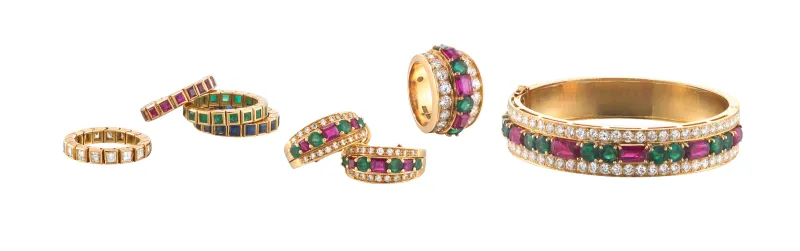
Photo: luxury gemstones collection sapphire ruby emerald diamond jewellery flat lay elegant, via www.christies.com
There is a moment, familiar to many who love jewellery, when a particular piece seems to choose you rather than the other way around. You reach for a ring or linger before a pendant and feel — quite inexplicably — that it belongs to you. What you may be responding to, without quite knowing it, is the symbolic resonance that certain stones and metals have accumulated across millennia of human culture. Long before jewellery became a matter of aesthetics alone, it was a language: a means of declaring allegiance, invoking protection, expressing grief, and marking the passage of a life.
At Sanctuary Jewellery, we believe that understanding this language deepens the relationship between a wearer and their collection. It transforms adornment from passive decoration into active meaning-making — a practice as ancient as civilisation itself.
The Diamond: Clarity, Constancy, and the Indestructible Self
No stone carries more cultural weight in the British imagination than the diamond. Its very name derives from the ancient Greek adamas — meaning unconquerable — and this etymology speaks to the symbolic role diamonds have played across diverse traditions. In medieval Europe, they were believed to offer protection against poison and ward off evil spirits; Indian royalty associated them with spiritual clarity and divine alignment.
Beyond the romance of engagement rings, which the Victorians did much to popularise, the diamond's deeper symbolism concerns the self rendered indestructible. It is a stone for those who seek resilience — not hardness of heart, but the kind of quiet, unyielding strength that endures seasons of difficulty without losing its brilliance. When chosen thoughtfully and sourced with integrity, a diamond piece becomes a private talisman of one's own endurance.
The Ruby: Sovereignty, Passion, and the Vital Force
If diamonds speak of constancy, rubies speak of fire. Prized above all other stones by the rulers of ancient Burma and revered in Sanskrit texts as ratnaraj — king of precious stones — the ruby has long been associated with vitality, courage, and the life force itself. Its deep red colour inevitably evokes blood and the heart, and many cultures attributed to it the power to protect its wearer from harm, particularly in battle.
In the British tradition, rubies appear throughout royal regalia and ecclesiastical jewellery, their warmth contrasting magnificently against yellow gold. To wear a ruby today is to participate in a lineage of sovereign confidence — to declare, without words, that one moves through the world with intention and passion. It is a stone well suited to landmark moments: a significant birthday, a hard-won professional achievement, or the beginning of a new chapter.
The Sapphire: Wisdom, Serenity, and the Examined Life
Few stones have been as consistently associated with the life of the mind as the sapphire. Ancient Persians believed the earth itself rested upon a great sapphire, whose reflection coloured the sky. Medieval scholars wore them as aids to contemplation; the clergy adopted them as emblems of heavenly truth. In the British consciousness, the sapphire holds particular cultural resonance — not least through its enduring association with royal devotion, from the engagement ring of Princess Diana to the continued prominence of the stone in ceremonial jewellery.
The symbolism of the sapphire is remarkably consistent across cultures: calm deliberation, intellectual integrity, and a certain elevated perspective on the turbulences of daily life. It is, in many respects, the stone of the sanctuary — a wearable reminder to pause, to consider, and to act from a place of stillness rather than reaction. For those who feel drawn to sapphires, the instinct is rarely merely aesthetic.
The Emerald: Growth, Renewal, and the Living World
The emerald's vivid green has always aligned it with nature's most fundamental promises: growth, fertility, and the annual miracle of renewal. Cleopatra was famously devoted to emeralds, claiming the mines of Egypt as her own; the Incas regarded them as sacred objects of spiritual power. In European heraldry, green signified hope and joy in abundance.
Worn today, an emerald piece carries this accumulated weight of the natural world's generosity. It speaks of an orientation towards growth — personal, creative, or relational — and of a deep attunement to the cycles that govern both landscapes and lives. It is a stone with particular resonance in the British context, where the landscape itself is defined by verdant abundance and where the changing of seasons remains a source of profound cultural meaning.
Pearl: Purity, Patience, and the Beauty Born of Difficulty
Unlike any gemstone, the pearl originates from a living creature's response to an irritant — a process of transformation that takes years of patient accretion. This origin story has made the pearl a universal symbol of wisdom acquired through experience, and of beauty that arises not despite difficulty but because of it.
In Britain, pearls have an especially rich heritage. They adorned the court dress of the Tudors, appeared in the portraiture of Elizabethan aristocracy, and have remained a staple of formal and ceremonial dress across the centuries. Yet their symbolism is far from merely conservative. The pearl speaks of the inner life refined by experience — of the self that has been tested and has emerged, quietly luminous, on the other side.
Metals as Meaning: Gold, Silver, and the Alchemy of Adornment
The stones alone do not complete the symbolic picture. The metals in which they are set carry their own ancient associations. Gold — solar, sovereign, and imperishable — has represented divine authority and enduring value in virtually every culture that has worked with it. Silver, by contrast, is lunar: associated with intuition, mystery, and the reflective, inward-looking aspects of the self. To choose a gold setting is often to make a statement of warmth and permanence; to choose silver is to align oneself with a quieter, more contemplative register.
Rose gold, a relative newcomer in historical terms, has acquired its own symbolic vocabulary in contemporary culture — one of warmth, tenderness, and a certain romantic softness that distinguishes it from the more formal associations of yellow gold.
Composing Your Collection with Intention
Understanding the symbolic grammar of gemstones does not mean one must approach a jewellery collection with scholarly rigour. Rather, it offers a framework — a way of understanding why certain pieces call to you at certain moments in your life, and why the collection you have assembled over years tells a coherent story about who you are and who you aspire to become.
At Sanctuary Jewellery, we invite you to consider your collection not as an accumulation of beautiful objects but as a developing vocabulary — a set of statements, quietly worn, about the values and intentions you carry into the world. The pieces you choose are not merely decorative. They are, in the oldest and most considered sense of the word, meaningful.