Where Light Dwells: The Luminous Alchemy of Handcrafted Jewellery

There is a moment, familiar to anyone who has worn or gifted a truly fine piece of jewellery, when the light catches it at an unexpected angle and something extraordinary occurs. The metal seems to breathe. A stone appears to harbour its own inner warmth. The piece, for a fraction of a second, becomes more than an object — it becomes a presence.
This is not poetry for its own sake. It is, in fact, a consequence of craft: of the particular way in which a skilled artisan's hands shape, finish, and coax metal and stone into forms that mass production simply cannot achieve. To understand why handcrafted jewellery catches light differently is to understand something essential about why it matters.
The Surface That Makes the Difference
At its most fundamental level, the way any jewel interacts with light is determined by the nature of its surface. Industrial manufacturing — the casting, stamping, and machine-polishing that underpins the high-street jewellery trade — produces surfaces of near-perfect regularity. Under magnification, a mass-produced ring or pendant will reveal a finish that is uniform to a degree that might initially seem desirable. In practice, however, this uniformity works against luminosity.
Light, when it strikes a perfectly flat, homogeneous surface, behaves predictably: it reflects in a single direction. The result is a hard, one-dimensional gleam — bright in one position, dull in another. There is no complexity, no invitation to linger.
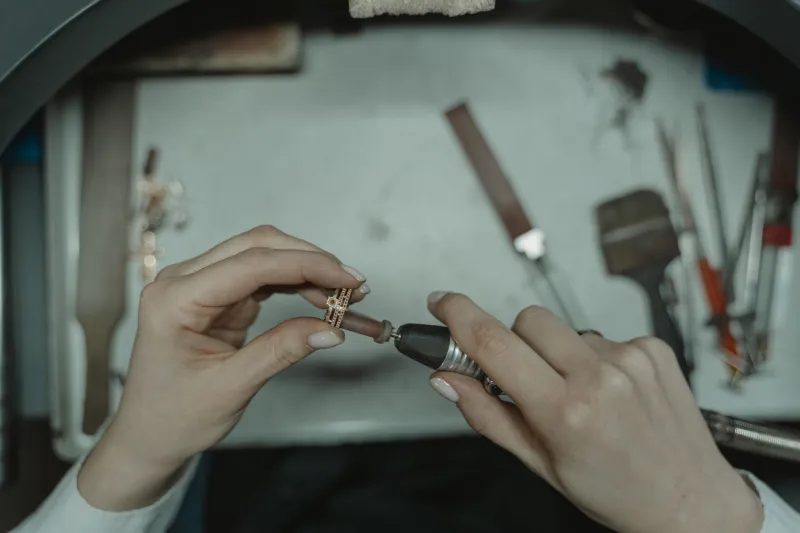
A handcrafted surface is an altogether different proposition. The artisan who hand-finishes a piece — working through successive grades of abrasive, applying burnishing tools with deliberate pressure, choosing where to leave the faintest trace of texture — creates a surface composed of thousands of micro-variations. These are not flaws. They are intentional inflections, the cumulative result of considered decisions made by someone who understands how light travels and where it pools.
When illumination falls across such a surface, it scatters. It refracts. It creates what jewellers sometimes describe as a "living" finish — one that shifts perceptibly as the wearer moves, as the angle of daylight changes through the hours, as candlelight or the warm glow of a lamp replaces the cool clarity of afternoon. The piece does not merely reflect its surroundings. It interprets them.
The Artisan's Understanding of Metal
British goldsmiths and silversmiths working in the artisanal tradition inherit a body of knowledge accumulated over centuries — knowledge that is inseparable from an intimate understanding of how different metals behave under light. Gold, silver, platinum, and their various alloys each possess distinct optical qualities: the warm, slightly reddish depth of 18-carat yellow gold; the cool, almost lunar luminescence of platinum; the mercurial brilliance of sterling silver.
An experienced maker does not simply shape metal — they work with its optical character. The decision to apply a satin finish to one area of a piece whilst leaving another highly polished is a considered act of light management. The contrast created between matt and burnished surfaces — a technique known as "contrast finishing" — generates a visual complexity that draws the eye and sustains interest in a way that a uniformly polished surface never could.
Similarly, techniques such as hand-engraving, repoussé work, and granulation — in which tiny spheres of metal are fused to a surface — all serve to create topographical variation that catches and redirects light in endlessly subtle ways. These are ancient skills, refined over millennia, and they remain the exclusive province of the craftsperson's hand. No automated process has successfully replicated their optical result.
Stone Setting and the Architecture of Illumination
The setting of a gemstone is, among other things, an act of light engineering. The manner in which a stone is held within its mount determines how much light reaches it from below, how freely it can interact with its surroundings, and how the metal itself frames and amplifies its colour.
Handcrafted settings are made to suit the individual stone — not the other way around. Where industrial production demands that stones conform to standardised dimensions and are placed into pre-formed mounts, an artisan will work with the specific character of a particular gem: its precise dimensions, the inclusions that give it personality, the way its facets have been cut, the subtle variation in its colour from one angle to another.
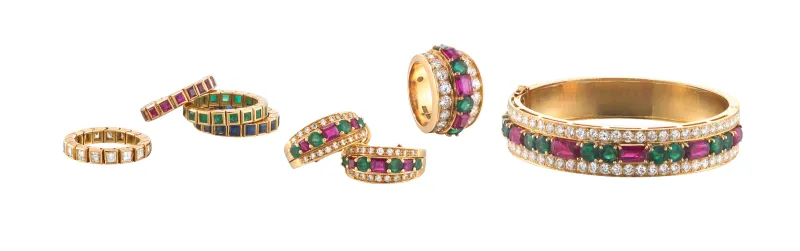
A bezel setting crafted by hand, for instance, can be burnished so that the metal edge follows the stone's girdle with a precision that maximises the flow of light into the pavilion — the lower portion of the gem — whilst creating a frame that complements rather than competes with the stone's own optical qualities. Prong settings, when made by hand, can be positioned and angled to allow maximum light entry whilst their tapered tips catch the light independently, adding further points of brilliance to the composition as a whole.
The result, when all of these decisions are made well, is a piece in which stone and metal seem to conspire together — each enhancing the luminosity of the other in a relationship that feels almost symbiotic.
Natural Light, Artificial Light, and the Passage of Time
One of the most telling distinctions between handcrafted and mass-produced jewellery emerges across the full spectrum of lighting conditions in which a piece is worn throughout a day. Under the cool, diffuse light of a British morning — that particular quality of overcast illumination so characteristic of our climate — a hand-finished piece will reveal its subtlety: the gentle undulation of its surface, the quiet depth of its metal, the considered relationship between its components.
As the day progresses and the wearer moves between environments — from natural daylight into artificially lit interiors, from the warmth of incandescent lamps into the cooler tones of contemporary LED lighting — the handcrafted piece adapts. Its micro-variations of surface ensure that there is always something catching, always a flicker of interest, always a reason for the eye to return.
Mass-produced jewellery, by contrast, often appears most impressive in the controlled, precisely directed lighting of a retail display case — conditions engineered specifically to flatter its particular optical character. Remove it from that environment and the brilliance frequently diminishes. The piece was made to sell, not to live.
The Investment in Illumination
There is, ultimately, a practical dimension to all of this. Jewellery that interacts richly with light is jewellery that is noticed — by the wearer, by those around them, by time itself. A piece that possesses genuine optical complexity does not fade into the background of daily life. It participates.
For those who seek jewellery as a genuine investment — not merely in the financial sense, but in the deeper sense of acquiring something that will reward attention over years and decades — the luminous qualities of handcrafted work are not an incidental pleasure. They are a core part of the value proposition.
At Sanctuary Jewellery, each piece is made with a conscious understanding of how it will inhabit light — in all its British variety, across all the occasions a life might bring. The shimmer you notice when you first try on a handcrafted piece is not accidental. It is the accumulated knowledge of a maker who understood, from the first mark on the metal, exactly where the light would dwell.