Carried Close: The Ancient and Enduring Language of Mourning Jewellery
There are losses that resist language. The absence of a mother, a child, a companion of forty years—these are not things that resolve themselves into sentences, however carefully chosen. They settle instead into the body, into the quiet hours, into the particular weight of a hand that now reaches for nothing. It is perhaps no surprise, then, that human beings have long turned to something physical, something wearable, something carried close to the skin, as a means of honouring what can no longer be spoken to.
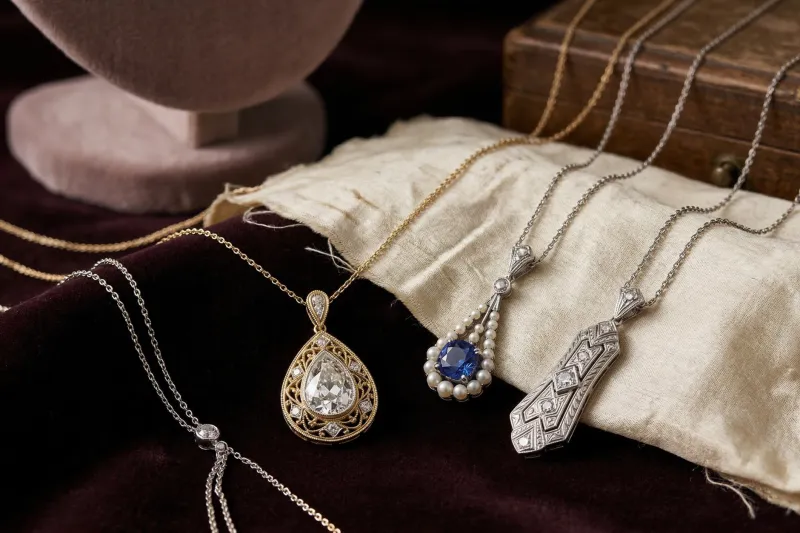
Mourning jewellery is among the oldest and most emotionally complex traditions in the history of adornment. Long before the language of grief counselling existed, craftspeople were fashioning small, exquisite objects designed to hold loss—to give it form, boundary, and a kind of permanence that memory alone cannot always sustain.
A Tradition Rooted in British Soil
In Britain, the formal culture of mourning jewellery reached its most elaborate expression during the Victorian period, when Queen Victoria's decades-long bereavement following the death of Prince Albert in 1861 effectively shaped the nation's relationship with public grief. Jet from Whitby—a dense, lustrous form of fossilised wood found along the North Yorkshire coast—became the material of an era, carved into brooches, bracelets, and pendants worn by women navigating the strict sartorial codes of official mourning.
But the tradition reaches back considerably further. Mourning rings, often engraved with the name and dates of the deceased, were distributed at funerals as far back as the seventeenth century—gifts to the living from the estate of the departed, a final act of connection across the threshold of death. Hair, that most intimate and imperishable of human materials, was woven, plaited, and set beneath crystal or glass in brooches and lockets, transforming something biological and transient into an object of extraordinary tenderness.
What strikes the modern observer is not the morbidity sometimes attributed to these pieces, but their radical intimacy. They were made with care and precision for a specific person, to mark a specific loss. They were, in the truest sense, handcrafted responses to the human condition.
The Memorial Commission: Grief Given Form
Today, the tradition continues—quietly, personally, and with a depth of intention that reflects how seriously many artisan jewellers take their role as custodians of other people's stories.
A growing number of independent British jewellers now offer memorial commission services: bespoke pieces designed in collaboration with those who are grieving, incorporating elements that carry direct significance—a birthstone, a favourite colour, a fragment of text from a letter never sent. Some craftspeople work with ashes, pressing them into resin or incorporating them into glass-set pendants. Others work with pressed flowers from a funeral, or with gold melted down from a ring that can no longer be worn on the finger for which it was made.
The process itself, those who have undertaken it often report, is unexpectedly healing. To sit with an artisan and attempt to describe a person—their particular quality of warmth, the way they laughed, what they valued most in life—is to engage in an act of active remembrance. It requires the bereaved to reach beyond the raw fact of absence and return, however briefly, to the fullness of the person who was. The resulting piece becomes not a monument to death but a celebration of a life, rendered in silver, gold, or stone.
Beyond Bereavement: Jewellery and Life's Transitions
Grief is not always the grief of death. There are other losses—of marriages, of identities, of selves we once inhabited and have since been required to leave behind. Divorce, illness, the departure of children into their own lives, the quiet grief of ageing—all of these carry a weight that can find unexpected solace in a considered, handcrafted object.
Some women commission jewellery to mark the end of a marriage—not as a gesture of bitterness, but as a reclamation. A ring remade into something entirely new; a pendant that incorporates a stone from a piece previously worn in another life, now reset into a form that speaks only of who she is now, and who she intends to become. The continuity of the material—the fact that the gold or the gem has a history—adds rather than detracts from the meaning. It acknowledges that we are always, in some sense, made of what came before.
In this way, memorial jewellery becomes something broader: a category of transitional objects in the psychological sense, pieces that help us move through change by anchoring us simultaneously to the past and to ourselves.
The Artisan's Responsibility
For the jeweller who undertakes memorial work, the commission carries a weight unlike almost any other. To hold someone's grief—to receive it, to listen carefully, and then to translate it into something of lasting beauty—demands not only technical mastery but a particular quality of human attentiveness.
The finest artisan jewellers approach this work with the gravity it deserves. They understand that the piece they are making will, in all likelihood, be among the most significant objects in another person's life. It will be worn on difficult anniversaries, on days when the loss returns with unexpected force, and on ordinary mornings when simply fastening a clasp becomes a small, private act of devotion to someone no longer present.
This is jewellery at its most essential—stripped of fashion, of trend, of any consideration beyond meaning. And it is, perhaps, the clearest expression of what handcraft has always been capable of: the transformation of material into something that genuinely matters.
A Sanctuary in Small Things
There is a reason we speak of jewellery as something worn—as distinct from something merely carried or displayed. To wear a piece is to bring it into constant, intimate contact with the body; to feel its weight, its temperature, its particular presence against the skin. For those who grieve, this physical proximity to an object that holds memory can offer a form of comfort that is quiet, private, and entirely one's own.
In a culture that often struggles to accommodate the slower, less linear aspects of loss—that expects grief to resolve itself within a reasonable timeframe and then politely withdraw—there is something quietly radical about choosing to carry it, literally and beautifully, as part of how one moves through the world.
Handcrafted mourning jewellery does not pretend that loss can be resolved. It does not offer consolation so much as companionship. It says: this mattered, this person mattered, and I will not pretend otherwise. And in the wearing of it, day after day, it becomes part of the fabric of a life—not a wound kept open, but a love kept present.
That, in the end, is the oldest and most honest function of jewellery: not to decorate, but to remember.