From Obligation to Ownership: Reimagining the Jewellery You've Inherited
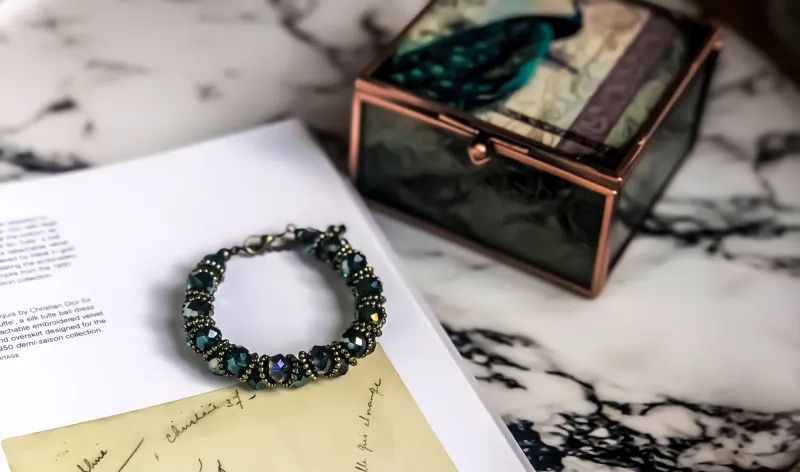
There is a particular kind of stillness that descends when you open a box left behind by someone you loved. Inside, nestled in faded velvet or wrapped in tissue that has softened with age, lie pieces that once adorned a grandmother's wrist, a mother's throat, an aunt's fingers on her wedding day. They are beautiful, perhaps. They are meaningful, certainly. But they are not, in any immediate sense, yours.
This is one of the more quietly complex situations that jewellery creates — the inherited piece that arrives with its own history, its own emotional gravity, and very little instruction on what to do next. Many of us tuck these treasures away, uncertain whether wearing them would feel presumptuous or whether leaving them unworn would constitute a kind of neglect. The jewellery box becomes a reliquary rather than a wardrobe, and the pieces inside gather dust whilst carrying a significance none of us quite know how to honour.
But there is another way — one that respects the past whilst making space for the present.
Begin with Assessment, Not Assumption
Before any decision is made about an inherited piece, it is worth understanding precisely what you have. This means looking beyond the surface sentiment and engaging with the object itself — its materials, its construction, its condition.
A visit to a reputable independent jeweller or a qualified gemmologist is an invaluable first step. In the United Kingdom, the National Association of Jewellers maintains directories of accredited professionals who can assess pieces with both technical rigour and appropriate sensitivity. What you learn may surprise you: that modest-looking brooch may contain a stone of genuine rarity; that heavy gold chain may be of far lesser carat than assumed; that curious mark stamped inside the ring band tells a story of Sheffield or Birmingham's storied metalworking heritage.
Hallmarks, in particular, are a remarkable archive. British hallmarking — one of the oldest consumer protection systems in the world — can pinpoint not only the metal's purity but the assay office through which the piece passed and the year in which it was tested. A piece bearing the anchor of the Birmingham Assay Office, the lion passant of sterling silver, and a date letter from the Edwardian era is not merely old jewellery. It is a document.
Understanding what a piece is made of, when it was made, and by what standard of craftsmanship it was constructed gives you a foundation from which to make genuinely informed choices — rather than decisions driven purely by guilt or uncertainty.
The Emotional Archaeology of Inherited Pieces
Assessment of the physical object is only one dimension of this process. Equally important is the internal work of understanding what these pieces mean to you — and what, honestly, they do not.
It is entirely possible to love someone deeply and find their jewellery aesthetically misaligned with your own sensibility. A heavy Victorian mourning brooch, a cluster ring in a setting that feels dated, a charm bracelet whose references belong entirely to another generation — these are objects shaped by lives that were not your own. Feeling no instinctive connection to them is not a failure of loyalty or affection. It is simply the truth of having a distinct identity.
Giving yourself permission to acknowledge this is, paradoxically, the first step towards a more genuine relationship with these pieces. When we stop performing attachment we do not feel, we create space to discover what we might actually want to do — and that is often something far more creative and meaningful than simply wearing a piece unchanged, or leaving it in a drawer.
Speak, if you can, to other family members about the history of significant pieces. Stories gathered now — who wore this, on what occasion, what it signified — become part of the provenance that any transformation should carry forward. Document what you learn. Photograph the pieces as they currently exist. These records are themselves a form of honouring.
The Craft of Transformation
Once you understand what you have and have sat with the emotional dimensions of the decision, the possibilities for reimagining inherited jewellery are genuinely expansive.
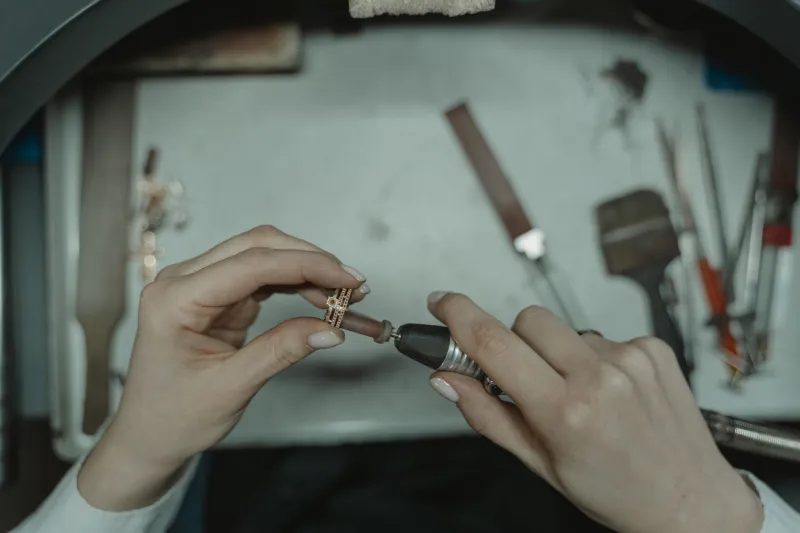
Remodelling — the practice of working with an artisan to reshape existing materials into an entirely new piece — has a long and honourable tradition in British jewellery. Gold from multiple pieces can be melted and recast; stones can be reset in contemporary or bespoke settings; chains can be shortened, lengthened, or combined. The material continuity remains even as the form changes entirely, creating something that is simultaneously new and ancient.
For those who have inherited multiple pieces from the same person, there is a particular beauty in commissioning a single work that draws from several sources. A ring that incorporates stones from three separate pieces — a pendant, a brooch, a pair of earrings — becomes a kind of portrait, a distillation of someone's taste and history into a single object that can be worn daily rather than stored indefinitely.
Independent jewellers who work by commission are natural partners for this kind of project. They are accustomed to working sensitively with inherited materials and the emotional complexity that accompanies them. The best amongst them will take time to understand not only the technical parameters of the work but the story you are trying to tell — and the sanctuary you are trying to create.
It is worth noting that even minimal interventions can be transformative. Replacing an outdated clasp, having a piece professionally cleaned and polished, or simply having stones re-secured in their settings can restore wearability to pieces that have lain dormant for years. Not every inherited jewel requires reinvention. Some require only attention.
When Keeping Means Letting Go
There are, of course, circumstances in which the most honest course is to pass a piece onwards — to another family member for whom it holds greater resonance, or even, in some cases, to sell or donate it thoughtfully. The value of inherited jewellery is not diminished by acknowledging when it does not belong with you. Forced retention serves neither the piece nor the person.
If a piece is of significant historical or monetary value, auction houses with specialist jewellery departments — Bonhams and Roseberys amongst them — can advise on appropriate routes to sale. The proceeds might fund a commission of something entirely your own, a new piece that carries no obligation but your own desire for beauty.
Making It Yours, Fully
The jewellery box inheritance is, at its heart, an invitation — one that arrives unexpectedly and asks more of us than we might initially expect. It asks us to engage with history, to practise discernment, to balance sentiment with honesty, and ultimately to make choices that reflect who we are rather than who we feel we ought to be.
When approached with care, the process of evaluating and reimagining inherited pieces can yield something remarkable: jewellery that is genuinely yours, rooted in the lives of those who came before but shaped entirely by your own hand. That is not a diminishment of what was given. It is, perhaps, the finest form of continuation.