The Considered Collection: Building a Jewellery Wardrobe That Speaks Only the Truth
There is a drawer in many homes — perhaps in yours — that tells a complicated story. Inside it lie the impulse purchases from holidays long past, the gifts accepted graciously but never truly loved, the trend-driven pieces that felt urgent for a single season and have not been touched since. Open it now, and you may find yourself looking not at a jewellery collection, but at a record of other people's expectations, fleeting fashions, and moments of indecision.
The question worth asking is not how to organise that drawer, but how to transform it entirely — into something that reflects the person you actually are, rather than the person various circumstances have nudged you into becoming.
Why Most Collections Grow Without Direction
Jewellery is uniquely susceptible to accumulation without intention. Unlike clothing, which wears out or falls from favour visibly, a piece of jewellery can sit quietly in a box for years, neither worn nor discarded, occupying a strange liminal space between possession and burden. We hold onto things because they were expensive, because someone we loved gave them to us, or simply because the act of letting go feels more decisive than we are prepared to be.
The result is a collection shaped by inertia rather than identity. Pieces jostle for space without any coherent narrative binding them together. When you reach for jewellery in the morning, the process becomes less an act of self-expression and more a kind of rummaging — and something important is lost in that friction.
Building a collection that genuinely reflects your most authentic self requires a different starting point entirely: not the jewellery box, but the self.
The Practice of Honest Inventory
Before acquiring anything new, there is considerable value in understanding what you already own — and, more precisely, why you own it. Lay every piece out before you. Not in a spirit of judgement, but of enquiry. Which pieces do you reach for instinctively, week after week, almost without thinking? Which ones do you handle with a vague sense of obligation before returning them, unworn, to their place?
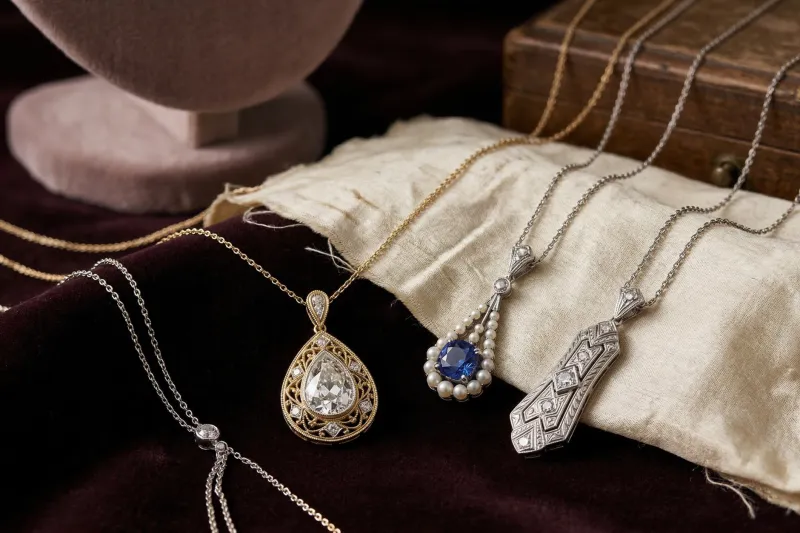
The pieces you wear repeatedly are telling you something essential. They are not merely your favourites; they are the items that feel, in some way, like extensions of yourself. Pay attention to their characteristics: the metals, the stones, the scale, the era from which they originate. A preference for understated Georgian-style hairwork mourning pieces speaks to a different sensibility than a love of bold, architectural contemporary silver. Neither is more valid — but recognising the distinction is the beginning of collecting with clarity.
The pieces you never wear deserve equal scrutiny. Ask honestly whether they belong in your life, or whether releasing them — to a family member who might cherish them, to a reputable auction house, to someone who will actually wear them — might be the most respectful thing you can do for both the piece and yourself.
Fewer Pieces, Greater Meaning
There is a persistent cultural myth that a jewellery collection is measured by its volume. Department store displays, gift guides, and social media feeds all conspire to suggest that more is the direction of travel. The reality, for those who have found genuine satisfaction in their collections, is almost always the opposite.
A small number of pieces worn regularly and with genuine affection will serve you far more richly than a drawer full of objects that never make it out of the house. This is not minimalism as aesthetic doctrine — it is simply the recognition that meaning is diluted by excess. When every piece matters, every piece is noticed. When you open your jewellery box and see only things you love, the act of choosing becomes a pleasure rather than an obligation.
This principle has particular resonance in the context of handcrafted jewellery, where each piece carries within it the time, skill, and considered intention of its maker. A single ring, forged by hand from ethically sourced gold and set with a stone chosen for its particular quality of light, carries a weight of meaning that no mass-produced equivalent can replicate. It becomes, in the truest sense, yours.
Curating Around a Personal Narrative
The most satisfying jewellery collections are those that tell a coherent story — not a story of wealth or status, but of a life genuinely lived. Consider what chapters of your own story matter most to you, and whether your collection reflects them.
Perhaps you are drawn to pieces connected to the landscapes of the British Isles — to the dark, heathered moorlands of the north, or the silver-grey light of a Scottish loch. Perhaps your collection is a quiet archive of the women in your family, each inherited piece a thread connecting you to generations past. Perhaps you are building something entirely forward-looking: commissioning pieces that mark the milestones of your own life as you move through it, rather than waiting for others to choose what those milestones should look like.
None of these approaches is more correct than another. What matters is that the collection has an internal logic — that it coheres around something real about who you are and what you value. A collection with that quality of integrity becomes, over time, one of the most honest portraits of a person that exists.
The Freedom of Intentional Ownership
There is a particular kind of freedom that comes from owning only what you genuinely love. It is the freedom of never feeling burdened by your possessions, never experiencing the low-grade guilt of the unworn and unloved, never reaching into a drawer with a sense of overwhelm.
When your collection is small and purposeful, each piece within it commands attention. You know the story of how each one came to you. You remember the jeweller who made it, or the grandmother who wore it, or the afternoon you spent deliberating over it before finally making it yours. That kind of knowledge transforms an object into something more — into what might genuinely be called a sanctuary: a place of rest, recognition, and return.
Building such a collection is not a project completed in an afternoon. It is, rather, a practice — one that deepens with time and self-knowledge, and that rewards patience above almost every other quality. Begin not with a shopping list, but with a question: what does the jewellery I already wear most often tell me about who I am? The answer, honestly considered, will point you towards everything you need.