The Clasp and the Crossing: How Small Jewellery Rituals Carry Us Through Life's Biggest Changes
There is a moment, familiar to many of us, that occurs just before we step out into something new. Perhaps it is a first day in a role we have long coveted, or the morning after a move to an unfamiliar city, or the quiet hour before a difficult conversation that will change the shape of a relationship. In that moment, we reach — often without conscious thought — for a specific piece of jewellery. A ring slid onto a particular finger. A chain fastened at the nape of the neck. A bracelet clicked into place at the wrist.
These gestures are small. They take seconds. And yet, for those who practise them, they carry an extraordinary weight.
The Ritual Beneath the Routine
Psychologists who study transitional behaviour have long noted the importance of what are sometimes called "bridging rituals" — small, embodied acts that help the mind move from one state of being to another. Unlike grand ceremonies, these private rituals require no audience. Their power lies precisely in their intimacy.
Dr Caroline Hartley, a London-based psychotherapist who specialises in identity and change, has observed this pattern repeatedly in her clinical work. "When people are navigating significant transitions," she explains, "they often anchor themselves through the body. Touch, texture, and repetition all signal to the nervous system that, despite external chaos, there is still a stable self at the centre of things. Jewellery is particularly effective in this regard because it sits on the body — it is not something you put down and forget."
This is not a modern phenomenon. The impulse to adorn oneself as a means of marking passage is as old as human culture itself. From Iron Age torcs worn into battle to Victorian mourning brooches pinned close to the heart, jewellery has always served as both symbol and talisman — a material expression of an interior state.
Collectors Speak
Speaking with those who have developed a conscious relationship with their jewellery reveals just how varied — and how deeply felt — these rituals can become.
Margaret, a 54-year-old architect from Edinburgh, describes the role that a particular handcrafted silver cuff played when she left a long-established practice to found her own studio. "I had worn it on special occasions for years, but during those first months of working alone, I started putting it on every morning. It sounds peculiar, but it genuinely helped. It reminded me of who I was before I became frightened."
For James, a 38-year-old teacher from Bristol who relocated to Glasgow following a divorce, a simple gold band — not a wedding ring, but one commissioned specifically to mark the transition — became central to his sense of continuity. "I wanted something that acknowledged the change without being defined by loss," he says. "Having it made to my own specification felt important. It was mine in a way that nothing else in that period was."
These accounts are not unusual. What is striking, however, is how frequently the pieces described are handcrafted — made by an individual maker, often to a specific brief. There appears to be something in the knowledge of a piece's origins that deepens its capacity to ground.
Why Handcrafted Pieces Hold Particular Power
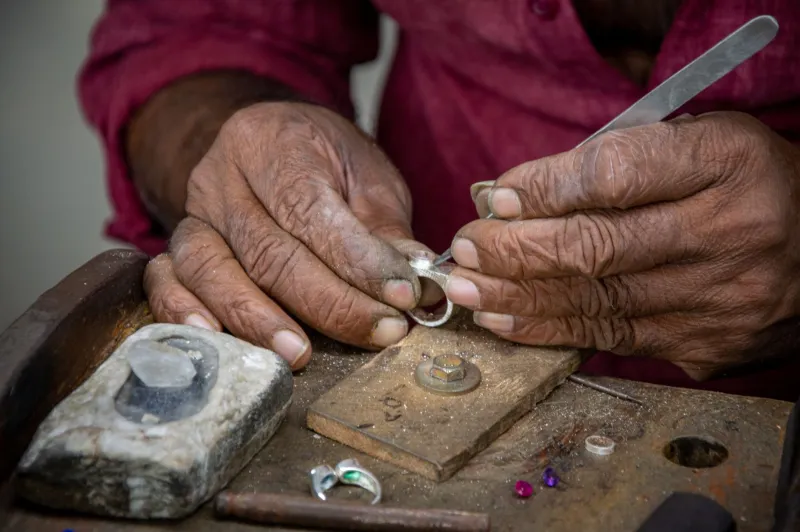
When a piece of jewellery has been made by hand — when you know that a skilled artisan shaped the metal, set the stone, and considered the proportions with deliberate care — it arrives already laden with human intention. It is not anonymous. It carries the trace of the maker alongside the meaning invested by the wearer.
This layering of significance matters enormously during times of transition. A mass-produced piece, however beautiful, cannot offer the same sense of singularity. But a handcrafted ring or pendant, made in a small workshop in Cornwall or the Scottish Borders, speaks of patience, of craft, of decisions made slowly and with purpose. In wearing it, one participates in that same quality of attention.
Dr Hartley observes that this is not incidental. "Objects that feel irreplaceable help us feel irreplaceable," she notes. "When someone commissions a piece or selects something they know to be genuinely unique, they are — on some level — asserting the value of their own experience. That is a psychologically significant act, particularly during periods when identity feels uncertain."
The Language of Transition
Different life changes seem to call forth different jewellery rituals, and the pieces selected often reflect the specific emotional register of the moment.
Relocation, for instance, frequently prompts people to seek out something rooted — a piece incorporating a stone native to a beloved landscape, or one made by a craftsperson connected to a place that holds meaning. The jewellery becomes a portable geography, carried into the unknown.
Career transitions, by contrast, often inspire a reaching towards pieces associated with authority or self-assurance — a bold cuff, a statement ring, something that speaks outwardly as well as inwardly. The jewellery is worn as much for the self as for the world.
Relationship milestones — not only marriage, but separations, reconciliations, the arrival of children, the loss of parents — tend to call forth the most emotionally complex pieces. Here, jewellery may be inherited, repurposed, commissioned, or carefully selected from an independent maker whose values feel aligned with the gravity of the moment.
The Act of Fastening
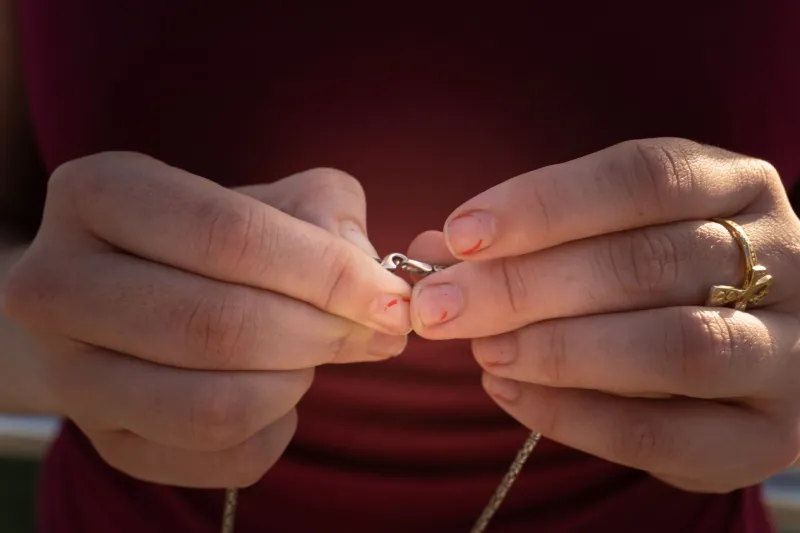
Perhaps the most underappreciated element of these rituals is the physical act itself. The clasp of a necklace. The push of a ring past the knuckle. The satisfying click of a bracelet. These micro-gestures are, in their way, a form of embodied declaration — a quiet commitment made each morning to carry something forward.
For those navigating change, this repetition becomes a form of practice. Each day, the piece is chosen again. Each day, the act of wearing it is renewed. There is something quietly courageous in that — a daily decision to remain oneself, even as so much else shifts.
At Sanctuary Jewellery, we have always understood that the pieces we seek out — and the makers we trust to create them — are rarely chosen by accident. They find us, as often as not, at precisely the moments when we most need to be found. The jewellery we return to in times of transition is not decorative. It is structural. It holds something in place that might otherwise come loose.
Choosing Your Anchor
If you are in the midst of a significant change — or sense one approaching — it may be worth considering what jewellery you reach for instinctively, and why. The piece need not be expensive, though it ought to feel considered. It should sit well on the body. It should carry a provenance you can speak to, even if only to yourself.
And if no such piece yet exists, the act of seeking one out — of working with a skilled maker to bring something into being that speaks to exactly where you are — may itself be part of the ritual. The search, the conversation, the waiting, the wearing: each stage a small ceremony of passage.
Life's crossings are rarely gentle. But we do not have to navigate them unadorned.