Something Old, Something Remade: The Craft of Transforming Inherited Jewellery With Integrity
There is a particular kind of guilt that settles upon those who inherit jewellery they cannot quite bring themselves to wear. A brooch from a grandmother who wore it every Sunday. A ring passed down through three generations, its shank worn thin with decades of devotion. These pieces arrive freighted with love, with memory, with a silent expectation that they will continue to be cherished — yet they may belong to another era, another aesthetic, another life entirely.
The instinct, for many, is simply to keep such items in a velvet-lined box, visited occasionally and admired in private. But there is another path — one that neither abandons the past nor forces the present into uncomfortable compromise. It is the path of thoughtful redesign: the art of transforming what has been into something that can genuinely be worn again, without diminishing a single thread of its emotional significance.
The Burden of the Beautiful
British families have long sustained a quiet tradition of passing jewellery between generations. Unlike furniture or silverware, jewellery is intimate — it has touched skin, marked occasions, absorbed the particular energy of a life lived. When a piece arrives in your hands, it carries with it not merely monetary value but a kind of accumulated meaning that resists easy categorisation.
Yet styles shift. A heavily ornamented Victorian mourning piece, however exquisite in its craftsmanship, may feel alien to someone whose taste runs to clean, contemporary lines. A cluster ring from the 1970s, beloved by the aunt who wore it daily, may simply not suit the hand of its new owner. These are not failures of sentiment — they are honest acknowledgements that jewellery, to fulfil its purpose, must be worn.
The question, then, is not whether to act, but how to act with sufficient care.
Beginning With Listening
Master craftspeople who specialise in heirloom redesign will often speak of the process beginning not at the workbench but in conversation. Before a single stone is set or a clasp examined, there is the matter of understanding what a piece means to the person who holds it.
What do you remember most clearly about seeing this piece worn? Which elements feel essential — the stone, the metal, the weight, the form? Is there a particular occasion or feeling you wish the redesigned piece to evoke? These are not merely sentimental questions; they are the foundation upon which every subsequent decision rests.
A skilled jeweller approaching this kind of commission operates, in some respects, more like an archivist than a designer. Their task is to identify what is irreplaceable — what constitutes the soul of the piece — and to build a new form around that irreducible core. The original stones may be recut and reset. The gold may be melted down and recast. But the provenance, the lineage, the story — these are carried forward intact.
What Can Be Preserved, and What Must Be Released
One of the more nuanced aspects of heirloom redesign is understanding the difference between what is sentimentally significant and what is merely familiar. Familiarity can masquerade as importance; the shape of a setting, for instance, may feel inseparable from a piece simply because it is how the piece has always looked — not because the setting itself holds meaning.
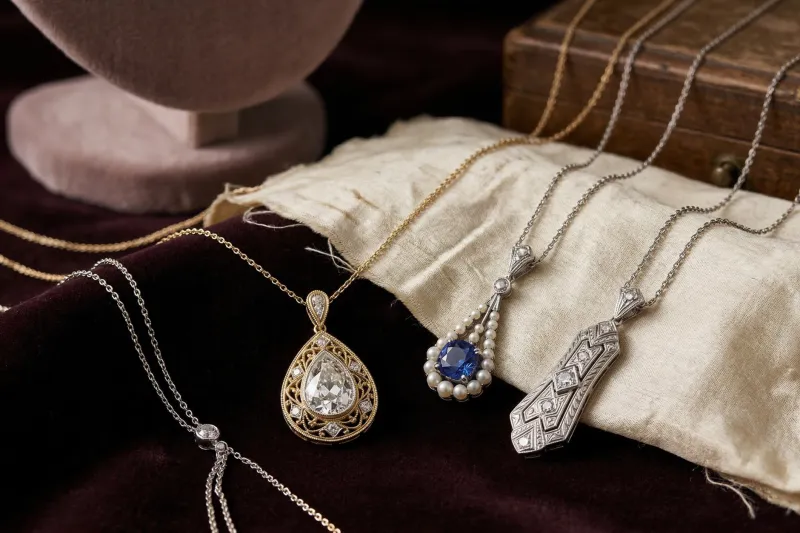
A craftsperson of genuine experience will help you make this distinction gently. They may explain that the central sapphire — vivid and deeply saturated, the colour of a winter sky — is the heart of the piece, whilst the surrounding marcasite cluster is a period detail that can be released without loss. Or they may identify that the engraving on the reverse of a locket, invisible to the outside world, is the element that must be preserved above all others, even if the locket itself is remade entirely.
This process of discernment is not always comfortable. It asks the inheritor to examine their attachment honestly, to separate emotion from aesthetics, and to make decisions that feel, at times, almost irreversible. Yet it is precisely this seriousness of purpose that distinguishes a thoughtful redesign from a casual alteration.
Techniques That Honour the Original
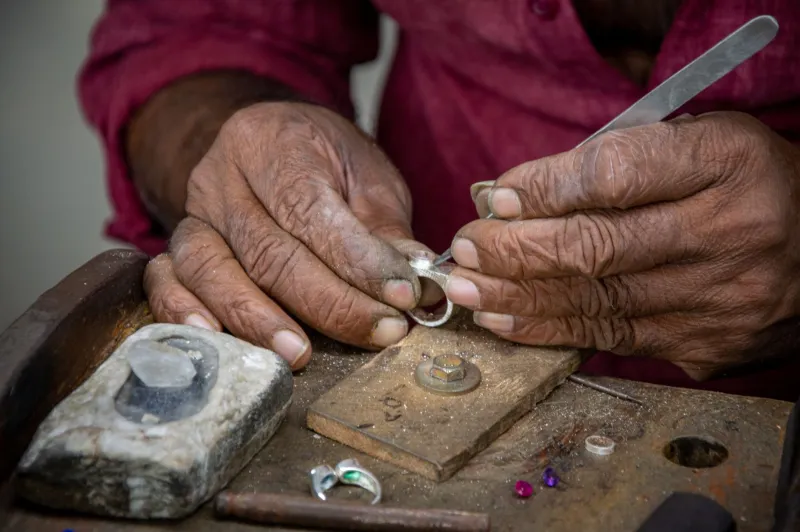
Contemporary craft offers a remarkable range of possibilities for those who wish to transform inherited pieces without erasing their origins. Stones can be recut from old European cuts into modern brilliant cuts — or, conversely, retained in their original cuts as a deliberate acknowledgement of their age. Yellow gold can be refined and recast into a cleaner, more contemporary silhouette, or alloyed with other metals to shift its tone whilst preserving its material identity.
For pieces where the metal itself has particular significance — perhaps a wedding ring worn for sixty years, or a chain that belonged to a great-grandparent — some craftspeople offer the option of incorporating a portion of the original material into the new piece, even if only in a structural element invisible to the eye. This practice, sometimes called material continuity, ensures that the physical substance of the original is genuinely present in what is created, rather than simply referenced.
Engravings, hallmarks, and maker's marks — where they exist — can often be preserved by incorporating a small section of the original piece into the redesigned work, or by taking a precise impression that is then reproduced in the new setting. These small acts of preservation carry disproportionate emotional weight.
The New Piece as Living Archive
What emerges from this process, when it is undertaken with sufficient care, is something genuinely remarkable: a piece that is entirely new in form yet entirely continuous in spirit. It can be worn daily, admired openly, and passed on in turn — accompanied now by a richer and more layered story than the one it arrived with.
There is something quietly profound in this. The jewellery that once resided, unworn, in a drawer becomes a living part of its new owner's life. The grandmother's stone rests now in a setting that suits the granddaughter's hand. The great-uncle's gold has been remade into something a nephew can wear with ease and genuine pleasure. The lineage continues — not in spite of the change, but because of it.
At Sanctuary Jewellery, we believe that the most meaningful pieces are those which carry history forward rather than preserve it under glass. To transform an inherited piece is not to diminish what came before; it is to honour it with use, with presence, with the willingness to let it become part of a new chapter whilst remaining anchored in all the ones that preceded it.
The soul of a piece of jewellery does not reside in its form alone. It resides in the intention with which it was made, the love with which it was worn, and the care with which it is carried forward. Redesign, approached with integrity, disturbs none of these things — and may, in time, deepen them considerably.