Written in the Deep: How a Gemstone's Geological Story Transforms the Way We Wear It
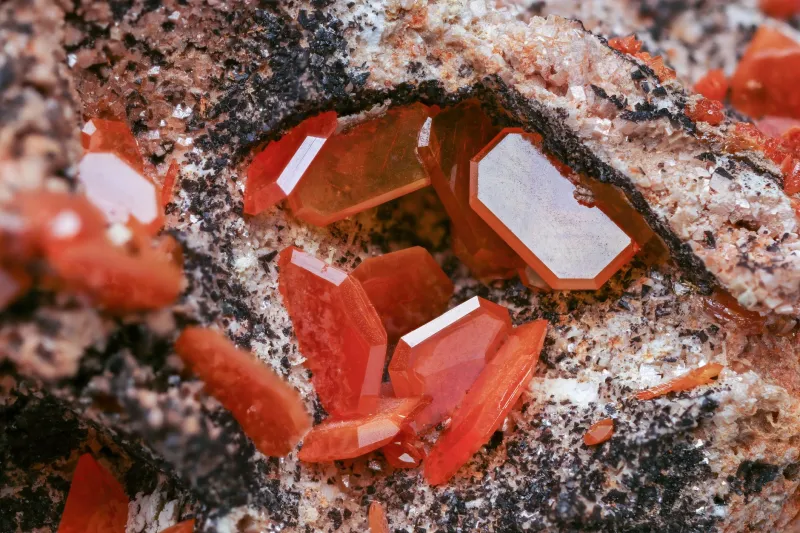
There is a particular stillness that settles over a person when they hold a piece of unset gemstone up to natural light. It is not simply the beauty of colour or the play of refraction that arrests the eye. It is something older, something that resists easy articulation — the faint but persistent sense that what you hold in your palm has been in the making for longer than the human mind can comfortably grasp.
For those who seek meaning in the jewellery they choose to wear, understanding the mineralogy of gemstones offers a form of sanctuary that goes well beyond the aesthetic. When a craftsperson sets a stone into silver or gold, they are not merely completing a design; they are framing a fragment of the earth's autobiography.
Millions of Years in a Single Setting
Consider the sapphire, that most serene of blue stones, prized by British jewellers and their clients for centuries. A sapphire is a variety of corundum — aluminium oxide — formed deep within the earth's crust under conditions of extreme heat and pressure, often within metamorphic or igneous rock formations. Some of the finest sapphires now reaching the market have been dated at over 150 million years old. The blue we admire, that singular depth of colour, is produced by trace amounts of iron and titanium locked within the crystal lattice during formation. The stone did not choose its colour; it received it from the precise chemical conditions of its birth.
This is not mere geological trivia. It is, for the thoughtful wearer, a form of grounding. To know that the sapphire at your throat has been shaped by forces utterly indifferent to human time — continental drift, volcanic activity, the slow cooling of magma — is to carry a quiet perspective wherever you go.
The Alchemy of Pressure and Time
Few stones illustrate the transformative power of geological process quite as dramatically as the diamond. Formed at depths of between 150 and 200 kilometres beneath the earth's surface, diamonds crystallise under pressures exceeding 45 kilobars and temperatures approaching 1,200 degrees Celsius. They are then carried upward through the crust by kimberlite eruptions — ancient volcanic events that ceased occurring on earth approximately 11,000 years ago. What this means, in practice, is that every diamond we hold has been waiting within the earth since before the last Ice Age reshaped the British landscape.
The carbon from which a diamond forms may itself be billions of years old, potentially drawn from the remains of organic material that existed before complex life developed on this planet. The notion that such a stone might be set into a handcrafted ring, worn on the hand of someone going about their daily life in Edinburgh or Bath or the Cotswolds, is one of those quietly staggering facts that jewellery, at its most considered, invites us to sit with.
Emeralds, Inclusions, and the Beauty of Imperfection
Emeralds present a different but equally compelling geological narrative. A variety of the mineral beryl, coloured by chromium and vanadium, emeralds form in hydrothermal veins — fractures in rock through which superheated, mineral-rich water has flowed over millennia. This process is inherently irregular, which is why emeralds almost universally contain what gemologists call jardin — the French word for garden — a network of internal inclusions, fractures, and growth irregularities that are unique to each stone.
Unlike diamonds, where clarity is prized and inclusions are considered flaws, the jardin of an emerald is part of its identity. No two are alike. Each internal landscape is a direct record of the specific geological conditions under which that stone grew: the temperature of the water, the mineral composition of the surrounding rock, the pace at which crystals formed. For those commissioning bespoke jewellery, the inclusion pattern of an emerald offers something remarkable — a provenance that is utterly unrepeatable.
Opals and the Science of Spectral Light
Perhaps no stone more vividly demonstrates the intersection of science and wonder than the opal. Unlike crystalline gemstones, opals are amorphous — they have no regular crystal structure. Instead, they are composed of microscopic spheres of hydrated silica, stacked in orderly arrays. When light enters an opal, it diffracts between these spheres, producing the phenomenon known as play-of-colour: that shifting, spectral dance of red, green, blue, and gold that has captivated jewellers and collectors throughout history.
The size of the silica spheres determines which colours are produced. Spheres of approximately 0.1 micrometres yield violet; larger spheres produce reds and oranges. This means that the specific colour palette of an individual opal is determined by geological accident — by the precise conditions under which those silica spheres settled and hardened, often over millions of years as water percolated through sedimentary rock. The fire in an opal is not decoration. It is physics made visible.
Knowing Your Stone More Deeply
For the British jewellery buyer, who increasingly approaches their purchases with discernment and a desire for genuine meaning, mineralogy offers a rewarding dimension of engagement. There is a meditative quality to learning the geological biography of a stone before it becomes part of your collection — understanding where it was formed, what conditions shaped it, and how long it waited within the earth before it was found.
This knowledge does not diminish the emotional resonance of a piece; it deepens it. A ring set with a Sri Lankan sapphire is also a ring set with 150 million years of geological history. A pendant featuring Colombian emerald carries within it the hydrothermal activity of the Andes. These are not metaphors. They are facts, and they are, in their own quiet way, extraordinary.
At Sanctuary Jewellery, we believe that the most meaningful pieces are those that reward close attention — not only in the craft of their making, but in the provenance of their materials. When a jeweller selects a stone with care, understanding its mineral character and geological origins, that knowledge becomes embedded in the finished piece. It is part of what a handcrafted jewel carries forward through time.
The Stone as Sanctuary
There is something deeply steadying about wearing a piece of the earth's history. In an age that prizes the immediate and the disposable, a gemstone formed over geological epochs offers a silent counterpoint. It has known pressures we cannot imagine, temperatures that would reduce everything we know to vapour, and the slow, unhurried passage of time measured not in years but in epochs.
To wear such a stone — to choose it thoughtfully, to understand something of its journey — is to carry a form of sanctuary that requires no explanation. It simply rests against the skin, ancient and serene, a reminder that beauty, at its most enduring, is never made in haste.