What Your Metal Says About You: The Quiet Eloquence of Alloy in Handcrafted Jewellery
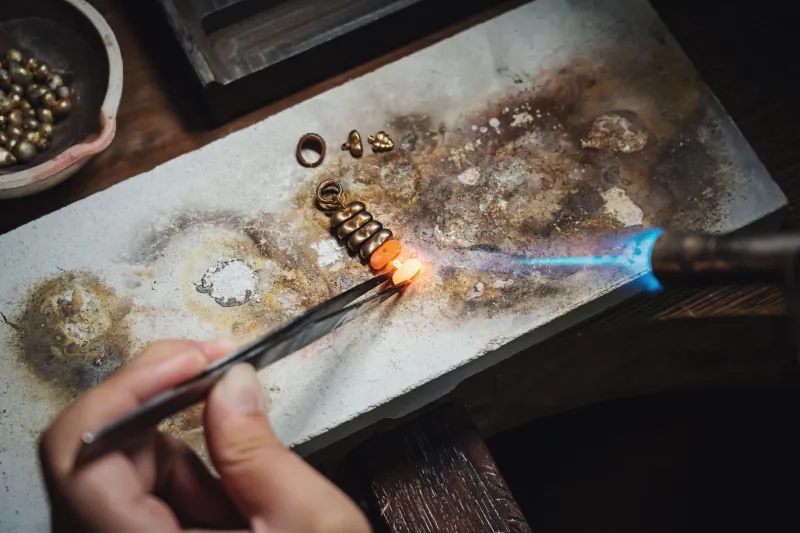
There is a moment, when a piece of jewellery is first placed in the hand, before it is examined for its stones or its setting, before its provenance is considered or its price remembered — when the metal itself makes its impression. It is cool or warm against the skin. It catches the light in a particular way. It carries a weight that is either reassuring or surprisingly delicate. That first encounter, largely wordless, is already a conversation. And the metal, it turns out, has been speaking long before we thought to listen.
For those who approach jewellery as something more than decoration — as sanctuary, as legacy, as a daily act of considered self-expression — the choice of alloy is rarely incidental. It is, in many ways, the foundational decision: the one that shapes every other element of a piece and, in doing so, quietly reflects something true about the person who will wear it.
Yellow Gold: Warmth, Authority, and the Long Memory of Civilisation
Yellow gold is the metal of record. It has been worked by human hands for at least six thousand years, appearing in the burial chambers of ancient Egypt, the workshops of Etruscan goldsmiths, the jewellery boxes of Tudor England, and the contemporary ateliers of independent British makers today. That continuity is not accidental. Gold does not corrode, does not tarnish, does not diminish. It persists — and in persisting, it accumulates meaning.
In its purest form, 24-carat gold is too soft for everyday wear, which is why it is almost always alloyed with copper, silver, or zinc to produce the 9ct, 18ct, and 22ct standards familiar to British buyers. Each grade represents a different balance between durability and richness of colour, but all share that distinctive warmth — a hue that has been associated across almost every human culture with solar energy, divine authority, and enduring worth.
To choose yellow gold is, in some sense, to align oneself with that long history. It is a declaration of confidence, of comfort with tradition, of an understanding that certain things do not require reinvention. British jewellers working in this metal often speak of a renewed appetite for it among customers who have grown weary of minimalism — those who want their jewellery to announce itself with a degree of assurance.
White Gold and Platinum: Precision, Restraint, and the Modern Inheritance
If yellow gold speaks in warm, rounded tones, white gold and platinum occupy a cooler register entirely. White gold — typically yellow gold alloyed with palladium or nickel and finished with a rhodium plating — achieved its greatest popularity during the Art Deco period of the 1920s and 1930s, when geometric precision and a certain studied restraint became the hallmarks of sophisticated taste. It remains enormously popular in Britain today, particularly for engagement rings, where its neutrality allows diamonds and coloured stones to command full attention.
Platinum, however, is a rather different proposition. Rarer than gold, heavier, and naturally white without any need for plating, it has long been regarded as the most prestigious of the precious metals. A platinum ring will wear differently over decades than a white gold equivalent — developing a gentle patina rather than losing material — and its density lends a satisfying solidity to the hand. Those who choose platinum are often drawn not merely to its appearance but to its biography: its resistance to change, its refusal to compromise.
For the British buyer who values understatement over ostentation — who prefers to let quality speak quietly rather than loudly — platinum and high-grade white gold offer a particular kind of sanctuary: one built on precision and permanence rather than warmth and history.
Rose Gold: Romanticism Reconsidered
The resurgence of rose gold over the past decade and a half has been one of the more culturally interesting developments in contemporary jewellery. Created by increasing the proportion of copper in the gold alloy, rose gold produces a blush hue that sits between the richness of yellow and the coolness of white — and it has found an audience among wearers who want something that feels both contemporary and tender.
There is a romanticism to rose gold that neither of its counterparts quite captures. It flatters a wide range of skin tones, pairs with both warm and cool stones, and carries a softness that many find more personally expressive than the authority of yellow or the precision of white. British jewellers have noted that rose gold often appeals to those commissioning pieces to mark moments of emotional significance — anniversaries, new beginnings, reconciliations — as though the warmth of the metal itself is felt to carry feeling.
Silver: Democratic Beauty and the Craft Tradition
To overlook silver in any serious discussion of jewellery metals would be a significant omission. Sterling silver — 92.5% pure, alloyed with copper for strength — has a history in British craft that is both ancient and fiercely alive. From the silversmithing guilds of mediaeval London to the thriving community of independent makers working in Sheffield, Birmingham, and across the Celtic nations today, silver has always been the metal of the artisan, the democratic material through which extraordinary skill finds expression without requiring extraordinary resources.
Silver tarnishes, and this is often cited as a limitation. But many who wear it regularly would argue precisely the opposite: that tarnish is evidence of a life lived, that polishing is itself a ritual of care, and that a piece of silver jewellery that has been worn and attended to over many years carries a particular kind of intimacy that more resistant metals cannot quite replicate. Silver is a metal that asks something of its wearer — and in doing so, deepens the relationship.
Contemporary Alloys and the Question of Values
Beyond the traditional precious metals, a growing number of British jewellers are working with alternatives that raise important questions about what we value when we choose a material. Recycled gold and silver — metals that have been refined and re-entered the supply chain without new extraction — now feature prominently in the offerings of ethically minded makers. Fairtrade gold, carrying certification that guarantees fair payment and safe conditions for artisanal miners, is increasingly sought by buyers for whom provenance is inseparable from beauty.
Titanium, palladium, and various modern alloys offer hypoallergenic properties and distinctive aesthetics for those whose skin or lifestyle demands something different. Each choice carries its own set of implications — ecological, cultural, personal — and the most thoughtful buyers are those who have considered not just how a metal looks, but what its presence in their jewellery box says about the kind of world they wish to support.
The Metal as Mirror
Ultimately, the choice of metal in a piece of handcrafted jewellery is an act of self-knowledge. It is an opportunity to ask what one truly values: warmth or precision, tradition or modernity, permanence or intimacy, restraint or richness. No answer is more correct than another. But the question itself is worth sitting with.
At Sanctuary Jewellery, we believe that the most enduring pieces are those in which every decision — including the foundational choice of alloy — has been made with genuine intention. When metal and maker and wearer are aligned in purpose, what results is not merely an object of beauty but a quiet form of sanctuary: something that holds its wearer, reflects their values, and speaks, in its own silent language, of who they are and what they cherish.