The Still Point: How Handcrafted Jewellery Offers Refuge in Britain's Age of Constant Connection
There is a particular kind of exhaustion that has become native to modern British life. It arrives not from physical labour but from the relentless accumulation of notifications, obligations, and the low-grade hum of a world that never quite switches off. We are, as a culture, perpetually mid-sentence — answering before the question has finished forming, scrolling before the thought has fully landed.
Against this backdrop, something small and seemingly unrelated has begun to assert itself with quiet authority. A ring worn on the middle finger. A pendant resting against the sternum. A bracelet that catches the light as the wrist turns over a keyboard. These are not grand gestures. They are, in the truest sense, still points — objects that ask nothing of us except that we notice them.
The Neuroscience of the Tactile Object
Researchers in the field of embodied cognition have long argued that our sense of self is not located solely in the mind but is distributed throughout the body and its relationship with the material world. When we touch something — truly touch it, with attention — we activate neural pathways associated with presence, calm, and the anchoring of attention in the immediate moment.
Handcrafted jewellery, by its very nature, rewards this kind of attention. Unlike mass-produced pieces stamped out in identical runs, a hand-forged piece carries within it the evidence of its own making. The surface of a hand-hammered silver band is not perfectly smooth; it holds the memory of each strike. A stone set by a craftsperson rather than a machine may sit at an angle imperceptibly — almost devotionally — its own. These small deviations are not flaws. They are invitations.
When the finger traces the slight ridge of a hand-soldered seam, or the thumb finds the cool, slightly uneven face of a cabochon stone, the nervous system responds. Psychologists refer to this as a grounding technique — the deliberate redirection of attention to physical sensation as a means of interrupting anxious or scattered thought. What jewellers have understood intuitively for centuries, neuroscience is now articulating with some precision: the meaningful object, worn close to the body, has the capacity to bring us home to ourselves.
What the Craftsperson Understands
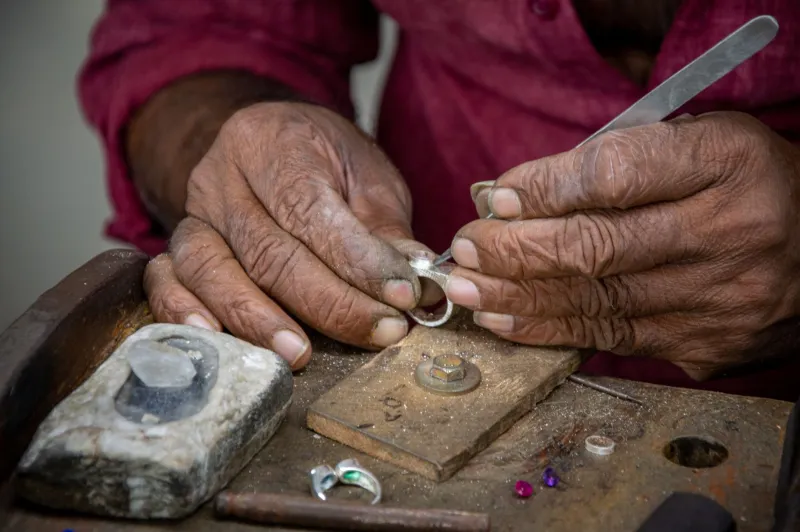
Speak to any jeweller who works by hand — who chooses the bench over the batch — and you will find a person who thinks carefully about the relationship between maker and wearer. The hours spent at a workbench are not merely productive; they are, in their own right, meditative. The filing, the polishing, the patient setting of a stone: these are acts that demand a quality of attention that digital life systematically erodes.
That quality of attention does not disappear when the piece leaves the workshop. It is, in some sense, transferred. A jewellery piece made with unhurried care carries within it a kind of encoded stillness — something the wearer can access simply by holding it, turning it, becoming aware of its presence against the skin.
This is not mysticism. It is, rather, a recognition that objects made with intention carry intention. And in a culture saturated with the disposable and the instant, the intentional object has become something quietly radical.
The British Relationship with the Meaningful Object
There is, in Britain, a long and underappreciated tradition of the object as anchor. From the mourning jewellery of the Victorian era — pieces that held hair, miniatures, and inscriptions close to the body — to the signet rings passed between generations in Scottish families, British culture has historically understood that certain objects are not merely decorative. They are relational. They connect us to people, to moments, to versions of ourselves we wish to remember or become.
What is changing now is not the impulse but the context. Where once the meaningful object served primarily as a vessel for memory or status, it is increasingly sought as a counterweight to overwhelm. Buyers speak of choosing a piece not because it matches an outfit but because it feels like something solid in an unsolid time. They describe the moment of putting on a particular necklace in the morning as a kind of ritual preparation — a way of gathering themselves before the day begins its demands.
This is the sanctuary effect in its most practical form: not withdrawal from the world, but the creation of a small, portable interior space that the world cannot easily enter.
Imperfection as Presence
There is a concept in Japanese aesthetics — wabi-sabi — that finds beauty in impermanence and imperfection. It is a philosophy that has found unexpected resonance in contemporary British sensibility, particularly among those who have grown weary of the frictionless and the flawless. The handcrafted jewellery piece, with its visible evidence of human making, speaks directly to this longing.
A slight asymmetry in a pair of earrings. The way a hand-cut gemstone refracts light differently from one angle to the next. The patina that develops on sterling silver worn daily against the skin. These are not deficiencies to be corrected; they are the markers of authenticity, of time, of a human hand at work. And it is precisely these qualities that make the piece available to the wearer as a grounding object — because perfection, by its nature, cannot be inhabited. Only the real can be touched.
Choosing with Intention
For those drawn to this quieter relationship with jewellery, the act of choosing a piece becomes itself a form of practice. Rather than purchasing reactively — impulse-driven, trend-chasing — the considered buyer approaches the decision with the same unhurried attention they hope the piece will eventually cultivate in them.
What does the piece ask of me? What does it give back? Does it feel like something I could wear on the worst Tuesday of a difficult month and find, in it, some small measure of steadiness?
These are not questions that a high-street display case tends to invite. They are, however, the questions that handcrafted jewellery — made by a person, for a person, with care for both — is quietly, persistently asking.
In the noise of everything, the still point holds. It always has. It is, perhaps, simply more necessary now than it has ever been.