Held Together: The Science and Craft of Jewellery as Emotional Sanctuary
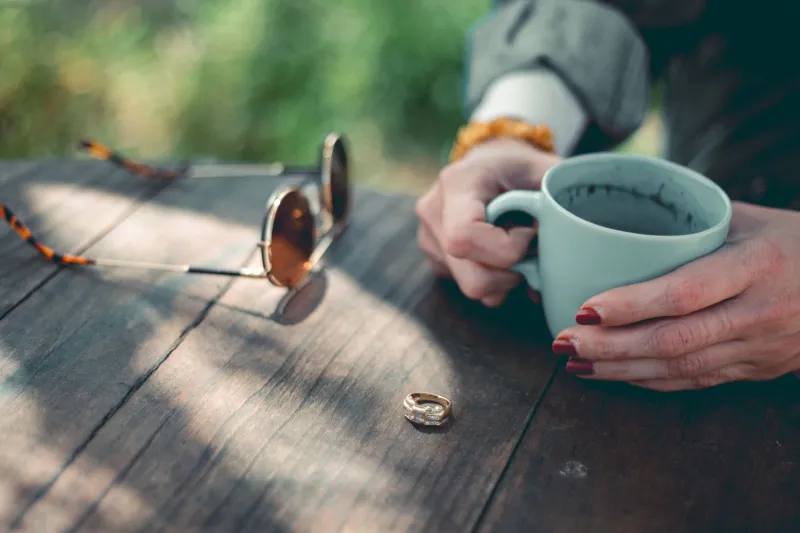
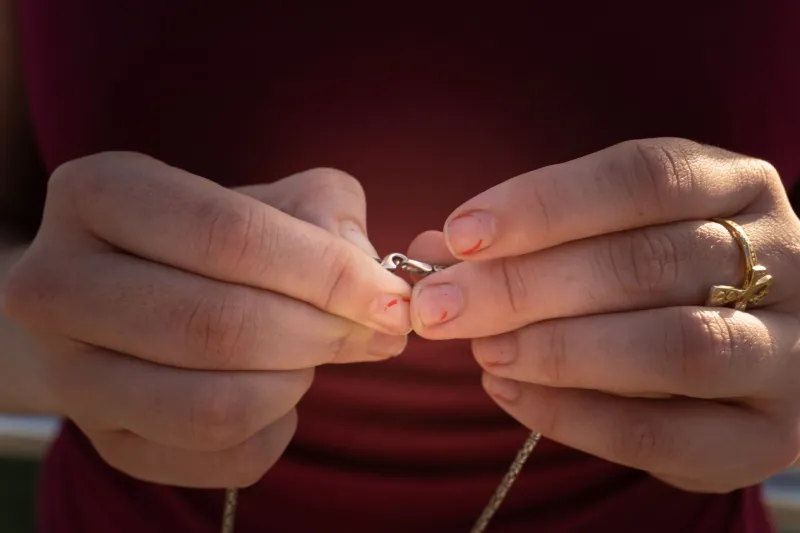
There are moments in life when the ground beneath us feels less than solid. A medical diagnosis. A sudden loss. The quiet, creeping anxiety of prolonged uncertainty. In such moments, many people describe reaching instinctively for something worn close to the body—a ring twisted slowly around a finger, a pendant pressed briefly against the sternum, a bracelet rolled between thumb and palm. The gesture is automatic, almost unconscious. Yet it is anything but arbitrary.
The relationship between handcrafted jewellery and emotional steadiness is one that has existed across cultures and centuries, and it is only now, through the lens of contemporary neuroscience and psychological research, that we are beginning to understand precisely why certain objects become so profoundly necessary to us.
The Nervous System and the Language of Touch
At the heart of this phenomenon lies what researchers call somatosensory grounding—the use of physical sensation to regulate the body's stress response. When the nervous system enters a heightened state of anxiety or distress, tactile input from the hands and fingers can interrupt the feedback loop of cortisol production and return the body, incrementally, to a calmer baseline.
This is not abstract theory. Studies in sensory psychology have demonstrated that repetitive tactile engagement with a familiar object—particularly one with consistent weight, temperature, and texture—activates the parasympathetic nervous system, sometimes described colloquially as the 'rest and digest' mode. The body, in short, is persuaded toward calm through touch.
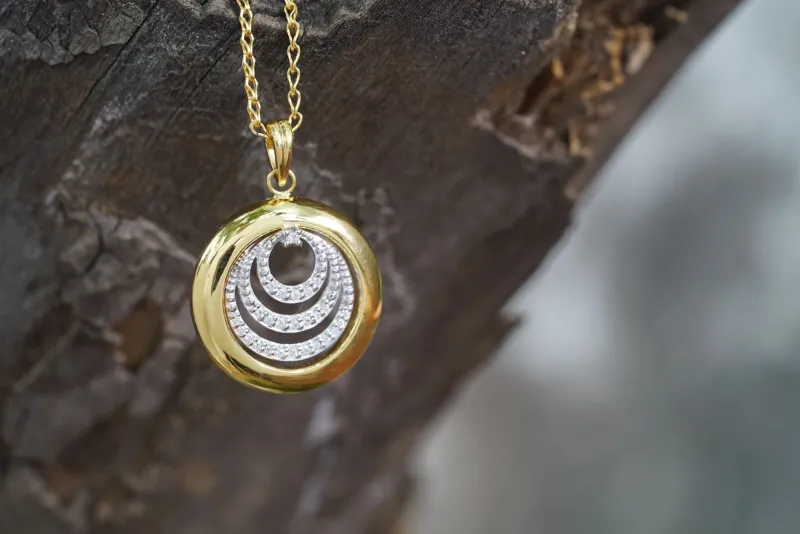
Jewellery, worn habitually and held in moments of distress, becomes precisely this kind of object. Its familiarity is encoded not only in memory but in the body itself. The weight of a particular gold bangle. The slight coolness of silver against warm skin. The gentle resistance of a stone set within a ring. These are not incidental qualities. They are, for those who know them intimately, a kind of language—one the nervous system speaks fluently.
Why Handcrafted Pieces Carry Greater Resonance
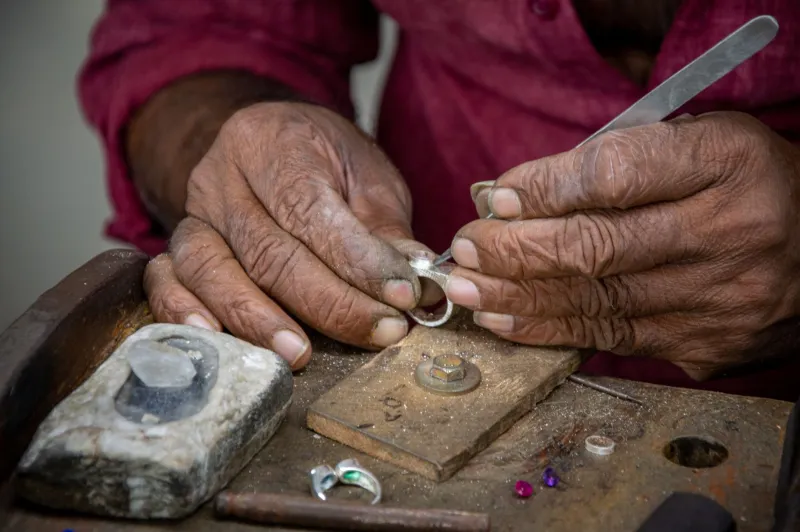
Not all jewellery serves this function equally well. There is a meaningful distinction between a piece produced in industrial volume and one shaped by the hands of a skilled artisan working deliberately, with full attention to material and form.
Handcrafted jewellery carries what might be described as intentional specificity. Each curve of a setting, each hammer mark softened but not erased, each stone selected for its particular quality of light—these are decisions made by a human being in real time, in response to the material before them. That specificity translates, however subliminally, into the experience of wearing the piece.
When we hold something made with genuine care, we are, in a sense, holding the concentrated attention of the person who made it. There is a growing body of psychological literature on what researchers term 'perceived intentionality'—the degree to which we attribute human thought and effort to an object—and its correlation with the emotional value we assign to that object. Handcrafted jewellery scores extraordinarily highly by this measure. We understand, often without needing to be told, that someone considered us—or at least considered the wearer—in the act of making.
The Role of Provenance in Deepening the Bond
Britain has a long and distinguished tradition of artisanal jewellery-making, from the silversmithing workshops of Birmingham's historic Jewellery Quarter to the independent goldsmithies of Edinburgh, Whitstable, and the Cornish coast. These are not merely geographic footnotes. They are threads of continuity that connect the piece on your wrist to a lineage of craft, knowledge, and material understanding stretching back generations.
Knowing where a piece comes from—who made it, from what materials, by what methods—adds a dimension of meaning that reinforces its capacity to ground us. Provenance is, in this sense, a form of emotional infrastructure. When you understand that a ring was wrought from ethically sourced gold by a craftsperson who trained for years in their discipline, the object becomes more than decorative. It becomes testimonial. It carries the evidence of human endurance, skill, and patience.
In uncertain times, this matters enormously. We are drawn to things that have been made to last, by people who understood what lasting means.
Design as a Form of Care
The finest jewellery designers working today are acutely aware of the emotional role their work plays. The best among them approach the design process not merely as an aesthetic exercise but as an act of considered empathy. How will this piece feel against the skin over many hours? What happens to its weight distribution when the wearer is still, or moving? Does the clasp open and close with a satisfying precision that communicates reliability?
These are not trivial questions. They are the questions of makers who understand that jewellery is worn not only on the body but, in a deeper sense, within the life of the person who chooses it. The tactile qualities of a piece—its heft, its smoothness, the slight resistance of a well-made hinge—are as much a part of its design as any visual element.
At Sanctuary Jewellery, this philosophy underpins every piece we curate. We are drawn to work that has been made with this understanding: that elegance is not merely visual, and that a truly beautiful piece of jewellery must also feel right in the hand, against the skin, and within the quieter moments of a life.
Finding Your Own Sanctuary
If you have not yet identified the piece that serves as your personal anchor, the process of finding it is worth undertaking with some deliberateness. Consider not only what appeals to you visually, but what you find yourself reaching for instinctively—or what you imagine reaching for in a difficult moment.
For some, it is something inherited: a grandmother's ring, a mother's brooch, an object that carries familial memory alongside its physical presence. For others, it is something entirely new, chosen or commissioned with a specific intention—a piece acquired to mark a transition, or to accompany a period of difficulty with something beautiful and enduring.
What matters is the quality of attention brought to the choice. Jewellery selected with genuine thoughtfulness—rather than impulse or obligation—is far more likely to become the kind of object you reach for when you need it most.
The Quiet Power of the Deliberate Object
We live in an era that valorises speed, efficiency, and the disposable. Against this backdrop, the handcrafted jewellery piece represents a quietly radical alternative: something made slowly, worn with intention, and kept for a lifetime. Its value is not diminished by use; if anything, it deepens. The ring worn through a decade of ordinary Tuesdays and extraordinary Wednesdays accumulates a kind of meaning that no amount of monetary value can replicate.
This is the sanctuary effect in its truest form—not a retreat from the world, but a point of stillness within it. A place to return to, held always at the wrist, the throat, or the finger, ready to remind us, through the simple fact of its presence, that some things are made to endure.