Marks of the Maker: How British Jewellers Are Preserving Their Creative Processes for Posterity
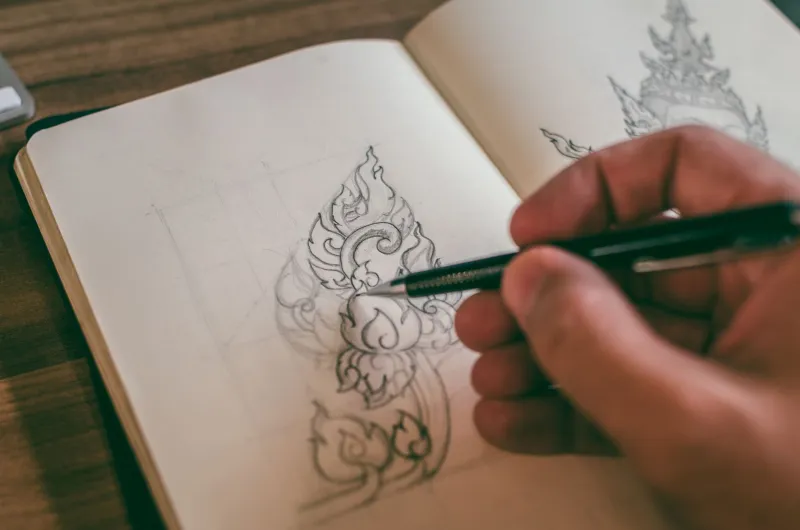
There is a particular kind of silence that settles over a jeweller's bench in the early hours of a working day. Before the torch is lit, before metal yields to hammer or file, there is thought—recorded, often, in pencil on paper. A line here, a note there. Measurements in the margin. A question mark beside a stone setting that has not yet resolved itself into certainty. These modest documents, rarely seen by the customer who ultimately receives the finished piece, are among the most intimate artefacts produced by British craft culture today.
In an age when so much of what we consume arrives without context—manufactured at distance, delivered without ceremony, replaced without grief—the documentation of making has become something quietly radical. Independent British jewellers are increasingly preserving the evidence of their creative labour: the working sketches, the annotated proofs, the maker's marks pressed into precious metal. And the customers who discover these hidden narratives are finding that their jewellery means something they had not anticipated.
The Sketchbook as Sacred Text
Ask any established independent jeweller to describe their design process and the conversation will almost inevitably return to paper. Digital tools have their place—computer-aided design has transformed precision and prototyping across the industry—but the initial gesture of creation remains, for many makers, an analogue act. The sketchbook is where instinct and intention first meet.
What makes these documents remarkable is their candour. A finished piece presents only resolution; the sketchbook preserves the uncertainty that preceded it. Crossed-out proportions, alternative stone arrangements, notes on the client's particular wishes, reminders about the quality of a specific batch of metal—these details constitute a biography of the object before it existed. They reveal not just what was made, but how it was thought.
Some British jewellers now offer clients access to this material as part of a bespoke commission. The sketchbook pages, or high-quality reproductions of them, are presented alongside the finished work. The effect is quietly transformative. A ring is no longer simply a ring; it is the answer to a series of questions, the resolution of a creative journey that the wearer can now trace from first mark to final polish.
Hallmarks and the Language of Accountability
Britain possesses one of the world's oldest and most rigorous systems of metal assay. The hallmark—those small, precise impressions struck into gold, silver, and platinum by one of the UK's four assay offices—is far more than a guarantee of metal purity. It is a form of authorship. It records where a piece was tested, when it was tested, and by implication, something of who made it.
For centuries, the maker's mark was the jeweller's signature, pressed into metal as a declaration of origin and accountability. In an era of mass production, such marks became largely ceremonial. But among independent makers working today, the maker's mark is being reclaimed as something more deliberate. It is a statement of presence: this piece came from these hands, in this workshop, at this particular moment in British craft history.
Customers who understand this language find themselves holding something considerably more significant than a decorative object. They hold a dated, verified record of provenance—one that, unlike a digital certificate or a printed receipt, is inscribed into the very substance of what they own.
The Hunger for Authenticity in a Curated World
It would be naïve to suggest that this renewed interest in maker documentation exists in isolation from broader cultural shifts. We live, in Britain as elsewhere, in a moment of profound information abundance and equally profound authenticity deficit. Consumers have grown sophisticated enough to distrust the polished surface, the seamless brand narrative, the carefully lit product photograph. They are seeking, with increasing urgency, the texture of the real.
Jewellery—handcrafted jewellery in particular—is uniquely positioned to answer this need. Unlike most luxury goods, a handmade piece carries within it the irreducible evidence of human involvement. Slight variations in surface finish, the particular quality of a hand-set stone, the barely perceptible irregularity that distinguishes the made from the manufactured: these are not flaws. They are signatures.
When makers choose to document and share their process—through the sketchbook, through the maker's mark, through the written record of materials sourced and decisions taken—they extend this authenticity beyond the object itself. The story behind the piece becomes part of the piece. And in a digital age where everything is content and nothing is context, that story carries extraordinary weight.
What Customers Are Really Seeking
Speak to those who commission bespoke jewellery from independent British makers and a consistent theme emerges: they are not simply purchasing an object. They are seeking a relationship with the process that produced it. They want to understand the choices made on their behalf—why this stone over that one, why this setting technique, why this particular gauge of metal. They want, in short, to know that someone thought carefully about them.
This is not vanity. It is a deeply human response to a world in which most transactions are frictionless precisely because they are impersonal. The bespoke jewellery commission reintroduces friction in the best possible sense: the productive resistance of genuine engagement, of one person's imagination meeting another's expertise across the intimacy of a shared creative endeavour.
The documentation of that endeavour—preserved in sketches, in marks, in the jeweller's own notes—becomes the evidence of care. It is proof that the piece was considered, not merely produced. And for the customer who receives it, that proof endures long after the initial delight of ownership has settled into the quiet satisfaction of something truly, irreplaceably theirs.
A Living Archive of British Making
There is a longer view to consider here. The sketchbooks and working documents that today's independent jewellers produce are, collectively, a record of British craft in this particular moment. They document not only individual creative processes but the aesthetic preoccupations, material concerns, and cultural influences of a generation of makers working through a period of considerable change.
Some of these documents will survive. They will be found in estate sales, donated to craft archives, passed between generations of jewellers as both technical reference and creative inspiration. The pieces they describe will, in many cases, have become heirlooms—worn through decades, handed down with their own accumulated stories. The documentation and the jewellery together will constitute something genuinely valuable: a layered record of making, wearing, and meaning.
At Sanctuary Jewellery, we believe that the value of a handcrafted piece is never fully contained within its material form. It resides equally in the intelligence and intention that preceded it—in the marks of the maker, visible and invisible, that transform precious metal and stone into something worthy of being carried close through a life.
To seek out jewellery made with this quality of attention is to participate in a tradition of discernment that Britain has long cultivated and that, in the present moment, feels more necessary than ever.