Spoken Without Words: How Handcrafted Jewellery Has Become the Most Eloquent Expression of Who We Are
There is a particular moment that many jewellery collectors describe in almost identical terms. It happens when a stranger pauses mid-conversation, their gaze drawn to a ring or a pendant, and says — almost involuntarily — where is that from? What follows is rarely a transaction. It is, more often, the beginning of a genuine exchange: about craft, about provenance, about the person who made the piece and the person now wearing it. In that moment, jewellery has done what language alone so frequently fails to do. It has told the truth.
This is the quiet revolution unfolding in British jewellery culture. At a time when digital life demands constant performance — the curated photograph, the considered caption, the personal brand maintained across multiple platforms — a growing number of people are turning to handcrafted adornment as a form of communication that cannot be edited after the fact. What you wear on your body, particularly when it has been made by hand and chosen with care, speaks before you do.
The Semiotics of the Handmade
Semiotics — the study of signs and symbols — has long been applied to fashion, but jewellery occupies a uniquely charged position within that field. Unlike a coat or a pair of shoes, jewellery is worn close to the skin, often touching pulse points, and is rarely removed entirely. It is, in a very literal sense, carried through life. And when a piece has been handcrafted — when it bears the subtle irregularities of a maker's touch, the considered choice of an ethically sourced stone, the weight of a metal worked by someone with genuine expertise — it carries a density of meaning that mass production simply cannot replicate.
Dr. Emma Sherwood, a consumer psychologist who has studied adornment behaviour across British demographic groups, describes handcrafted jewellery as functioning like a material autobiography. 'When someone chooses a piece that has been made by hand,' she has noted, 'they are not simply buying an object. They are aligning themselves with a set of values — patience, authenticity, the rejection of disposability. And other people read that alignment, often unconsciously, before a single word is exchanged.'
This is not merely theory. Collectors across the United Kingdom speak with striking consistency about the social function of their chosen pieces. A silversmith's cuff worn to a board meeting. A stone-set pendant selected for a first date. A pair of hammered gold earrings that have, on more than one occasion, prompted the question: are you someone who values things made to last? The answer, of course, is always yes.
A Signal in an Age of Noise
The cultural context matters enormously here. We live, as many observers have noted, in an age of profound informational saturation. British consumers are exposed to thousands of commercial messages each day, and the instinct to distrust — to look past the polished surface toward something more genuine — has never been stronger. In this environment, the handcrafted object possesses an almost radical authenticity.
Mass-produced jewellery, however beautiful in isolation, carries an implicit message: this was made for everyone. The handcrafted alternative says something entirely different. It says: this was made by someone, and I chose it deliberately. That distinction, apparently simple, carries considerable social weight.
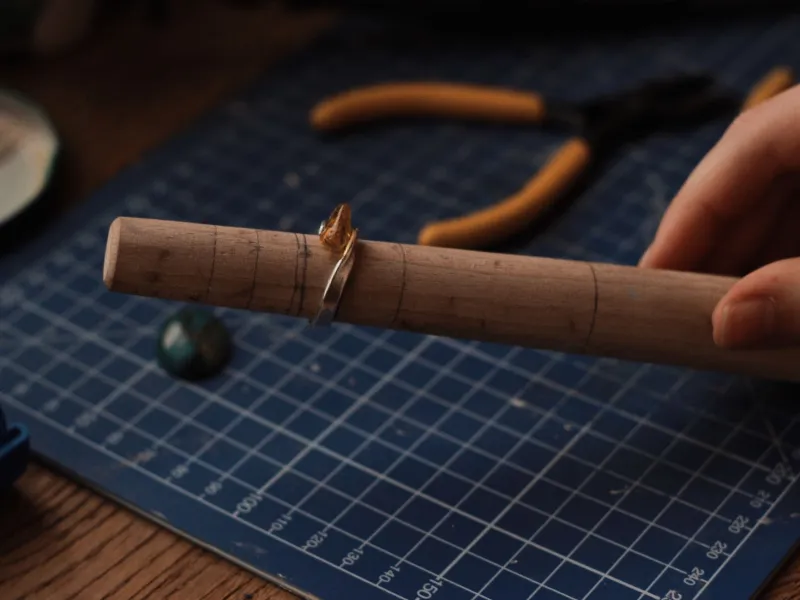
Amelia Cartwright, a Birmingham-based goldsmith who has been working in her craft for over two decades, puts it plainly. 'My clients often tell me they're not looking for jewellery that shouts,' she says. 'They want something that only speaks to those who are paying attention. A piece that rewards a second look. That's what handwork gives you — a depth that reveals itself slowly.'
This preference for the considered over the conspicuous reflects a broader shift in British luxury sensibility. The most discerning buyers are moving away from logo-driven status signalling and toward what might be called provenance literacy — an appreciation for objects whose value lies in their making as much as their material. Handcrafted jewellery sits at the very heart of this shift.
The Collector as Narrator
For those who build their collections over time, handcrafted jewellery functions not merely as self-expression but as autobiography. Each piece marks a moment, reflects a sensibility, or embodies a relationship. Worn together, they constitute something remarkably close to a life story — one that can be read, at least partially, by anyone with the discernment to look.
Susannah Holt, a Londoner in her early fifties who has been collecting artisanal jewellery for nearly thirty years, describes her collection as 'the most honest version of myself I have ever put forward.' Her pieces range from a delicate labradorite ring commissioned from a Scottish maker during a difficult personal period, to a pair of oxidised silver earrings she purchased at a craft fair in Cornwall on the day she decided to change careers. 'Every piece remembers something,' she says. 'And when I wear them, I remember it too. But so, in a way, do the people I meet.'
This narrative dimension — the sense that jewellery accumulates meaning through time and wearing — is something that handcrafted pieces carry with particular potency. The slight patina of a much-loved ring, the gentle wear on the clasp of a frequently used pendant: these are not flaws but records. They speak of a life lived in full, of an object cherished rather than discarded.
Choosing Your Signature
There is, of course, a practical dimension to all of this. For those considering how to use jewellery more intentionally as a form of self-expression, the starting point is almost always the same: clarity of intention. What do you wish to communicate? Not to others, necessarily — though that is a natural consequence — but to yourself. What values do you wish to embody? What stories do you wish to carry?
The answers to these questions, when held up against the work of skilled British jewellers and artisanal makers, have a way of finding their form. A piece chosen with this kind of deliberateness becomes something more than an accessory. It becomes a signature — as individual and as legible, to those who know how to read it, as a handwritten name.
At Sanctuary Jewellery, this principle informs every piece within our collection. Each item has been made by hand, chosen for its integrity of craft and provenance, and offered to those who understand that true elegance is never accidental. It is, always, the result of a considered choice — and it speaks, to those willing to listen, with uncommon clarity.
In a world that rarely stops talking, there is a profound kind of power in letting your jewellery speak for you.